The schoolhouse that hadn’t been built yet
Which building was James Rigby standing in when he heard the guns at Brandywine?
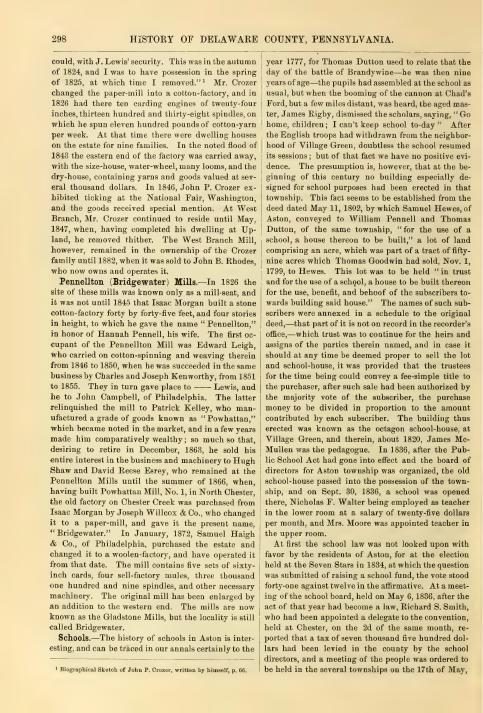
Our notes had said the octagon school-house at Village Green since the first week of the project. The octagon appears in the Aston township chapter of Ashmead’s county history a few lines from the Brandywine story, and the two had been read as one passage. They are not. Ashmead, page 298:
The presumption is, however, that at the beginning of this century no building especially designed for school purposes had been erected in that township. This fact seems to be established from the deed dated May 11, 1802, by which Samuel Hewes, of Aston, conveyed to William Pennell and Thomas Dutton … “for the use of a school, a house thereon to be built,” a lot of land comprising an acre … The building thus erected was known as the octagon school-house, at Village Green. Henry Graham Ashmead, History of Delaware County, Pennsylvania (1884), p. 298
James Rigby died on 9 March 1801, fourteen months before that deed. The octagon school-house did not exist in 1777.
What Ashmead attests is a school, not a schoolhouse. He dates the history of schools in Aston “certainly to the year 1777” on Thomas Dutton’s recollection alone, and states that the township had no purpose-built schoolroom before 1802. In September 1777 the school met in an ordinary building — a rented room, a dwelling, a shop — at or near Village Green. Which one is not known.
Search for “octagon schoolhouse Brandywine” and you will land on the Birmingham octagonal schoolhouse — a real octagon that really does stand on the battlefield, in Birmingham Township, Chester County. It was built in 1819.
So there are two octagon schoolhouses about eight miles apart in two different counties, and neither existed in 1777. The anecdote does not place him on the battlefield: Village Green is roughly eight miles east of Chadds Ford, and he heard the guns from there.
Two smaller corrections came out of the same check.
We had recorded a guess that James’s five acres and eighty perches in Aston might be the octagon’s ground. It is not: the octagon’s lot was Samuel Hewes’s one acre, taken out of a fifty-nine-acre tract he bought from Thomas Goodwin in 1799.
And Thomas Dutton was eight, not nine. Ashmead says nine; the 1899 newspaper account says eight. Ashmead also prints Dutton’s birth as 2 February 1769, which makes him eight years and seven months on the day of the battle.
Where was the 1777 school? Three places to look: the 1798 Direct Tax general list, which describes buildings individually; Ashmead’s property notes for Village Green in the same chapter; and the subscribers’ schedule annexed to the 1802 deed, which Ashmead says was never recorded but which would name the families paying for schooling in Aston.