Hannah Brown is the most fully documented member of her generation of this family. Her marriage to James Rigby around 1757 brought a disciplinary case at Concord Monthly Meeting that ran for nine months and produced about a dozen pages of minutes. Those minutes date the marriage, name her father, and identify her husband’s religion — none of which any other source does.
Her peopleDaughter of Daniel Brown
She was the daughter of Daniel Brown of Upper Chichester, a Quaker farmer with seventy acres and a dwelling. His will, made in 1767 and proved that December, names “Hannah, wife of James Rigby” — the earliest document in which the couple appear together, and the one that fixes her parentage beyond argument.
The old county history had given James Rigby’s wife as “probably Rachel.” Rachel was Daniel Brown’s granddaughter, who married John Dutton; the will names her and Hannah a line apart.
Her birth is not registered anywhere we have found — not in the Concord register, not on the Friends Historical Library card that records the rest of her life. The Harlan genealogy of 1914 says she was born in Chichester Township, which is consistent with everything else and rests on family memory rather than a record.
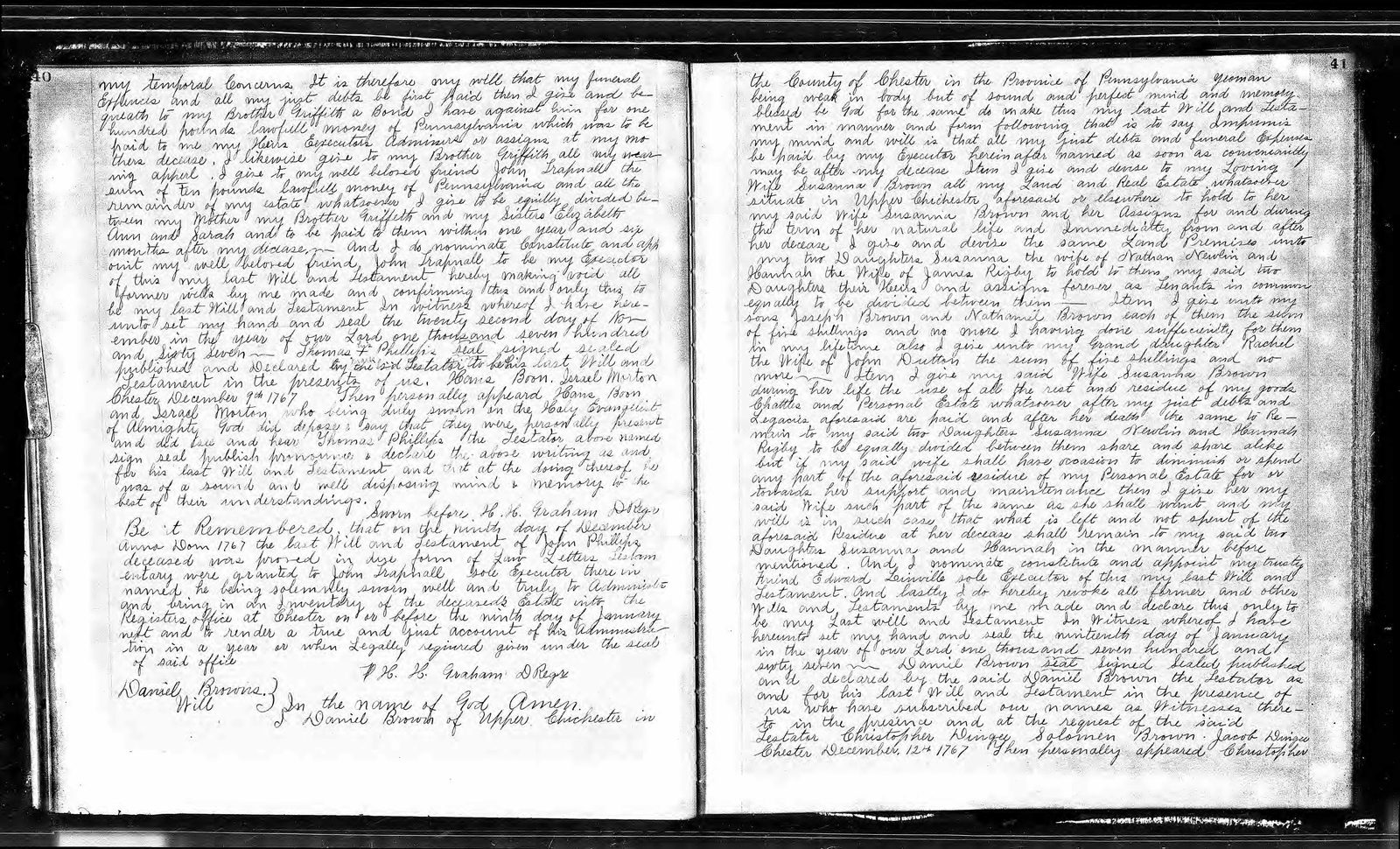
Daniel Brown’s will, 1767, proved 12 December that year. It names his sons Joseph and Nathaniel, his granddaughter Rachel married to John Dutton, and “Hannah, wife of James Rigby.”
Ancestry’s index for the same document lists James Rigby as son-in-law — a relationship the county history had been guessing at for a hundred years.
… Hannah, wife of James Rigby …
1758“By the Assistance of a Priest”
Friends married one another in meeting, before witnesses, with the meeting’s permission. Marrying outside that order — particularly before a clergyman — was a disciplinary matter. Hannah married James Rigby, who was Anglican, and in the spring of 1758 Concord Monthly Meeting took up her case.
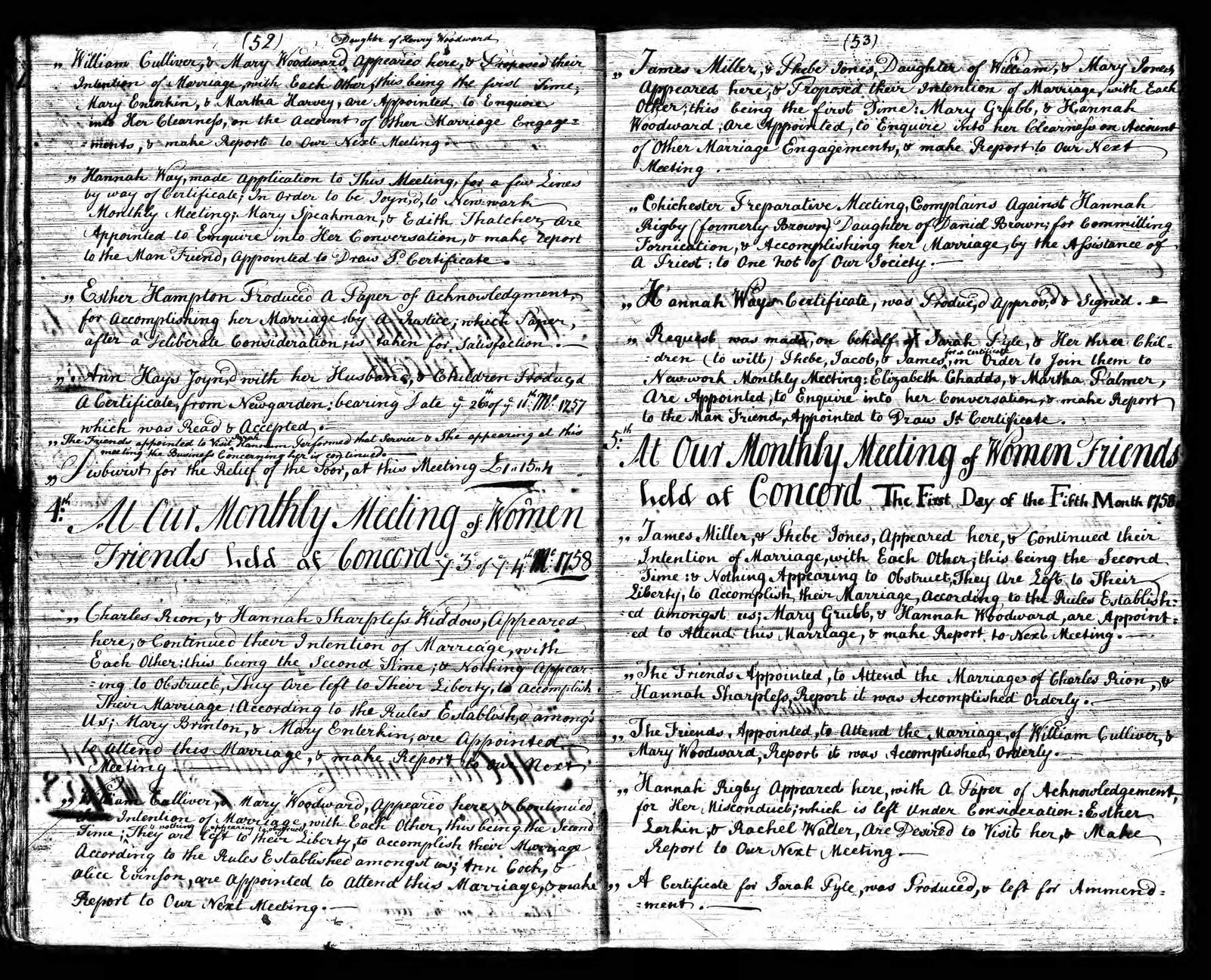
The complaint is entered in the women’s minutes in the fourth month, in the meeting’s standard formula: married “by the Assistance of A Priest.” In Quaker usage priest means a Church of England minister. This is the earliest evidence of James Rigby’s religion, two years before the St Martin’s vestry book records him as clerk.
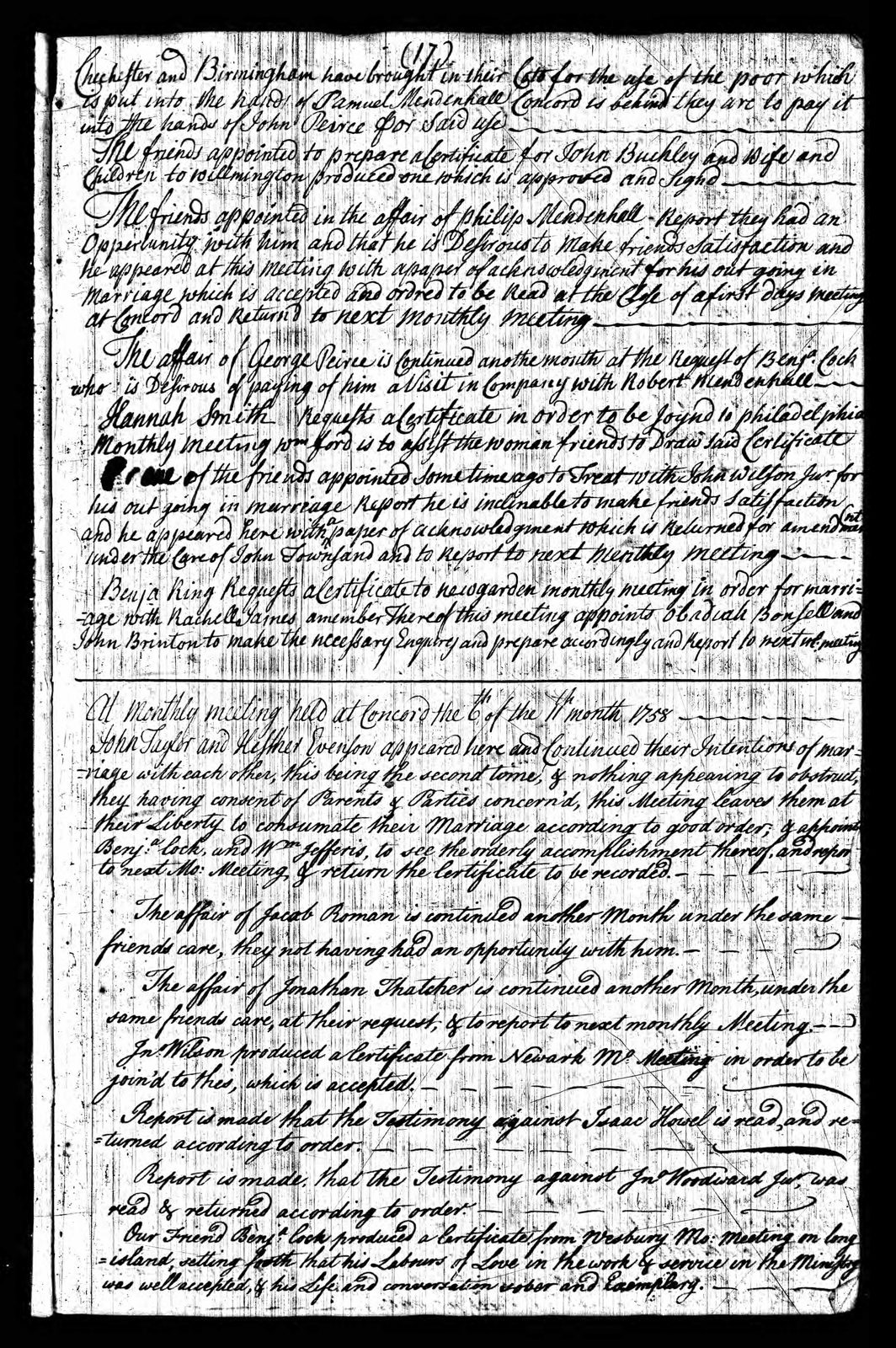
The case ran for the better part of a year and it is unusually well preserved. The women’s minutes carry the complaint and its continuations across pages 52 through 59; the men’s minutes follow the paperwork from page 14 to page 20.
| Month | What happened | Where |
|---|---|---|
| 4th mo. 1758 | Complaint entered against Hannah Rigby, formerly Brown, for marrying out of unity | Women’s minutes, pp. 52–53 |
| 5th–7th mo. | Continued while Friends visit her | Women’s minutes, pp. 54–55 |
| 8th mo. | A testimony of disownment is ordered drawn up | Men’s minutes, p. 14 |
| 9th mo. | Hannah offers a paper of acknowledgment | Men’s minutes, p. 15; women’s pp. 58–59 |
| 10th mo. | The paper is returned to her for amendment | Men’s minutes, p. 16 |
| 11th mo. 1758 | Accepted — and ordered to be read publicly at Chichester | Men’s minutes, p. 17 |
| 12th mo. | Not yet read; carried over | Men’s minutes, p. 19 |
| 1st mo. 1759 | Read. Case closed. | Men’s minutes, p. 20 |
⟦ not yet transcribed ⟧
She was disowned in the spring, acknowledged her fault in the autumn, and was a member again by the beginning of 1759 — and remained one for the next sixty-six years. An acknowledgment was not a renunciation of the marriage, which stood. It was an admission that she had gone about it outside the meeting’s order.
A patternThree Generations of Rigby Wives
Hannah was not the last. Her son Eli married Elizabeth Harlan in 1796 — and the Harlan genealogy says they married near Doe Run village, not at Doe Run Meeting. Her grandson Seth married Lydia John in Philadelphia in 1829, and Chester Monthly Meeting complained of Lydia in its women’s minutes for marrying by a magistrate.
Hannah 1758. Elizabeth 1796. Lydia 1829. Three consecutive generations of Quaker women marrying Rigby men outside their meeting’s order. The first and third are documented; the middle one is suspected and unproven.
Hannah was restored and died a member. On the evidence of the Concord register, none of the wives after her was.
8 June 1824Buried at Chichester
She died on 8 June 1824, aged 88 — twenty-three years after her husband — and the Concord Monthly Meeting births-and-burials register records her burial at Chichester. She is on page 8, and she is the only Rigby in the entire volume.
A Friends register recorded members. Non-member husbands and children were commonly buried in the ground and left out of the book, so the register’s silence about James says nothing about where he lies. What it does establish is that Hannah was the only Friend in the household.
Her death is also entered in a private family memorandum book kept in the Dutton household, the same book that records James’s death in 1801. Those are the only two Rigby entries in its seventy-eight pages.
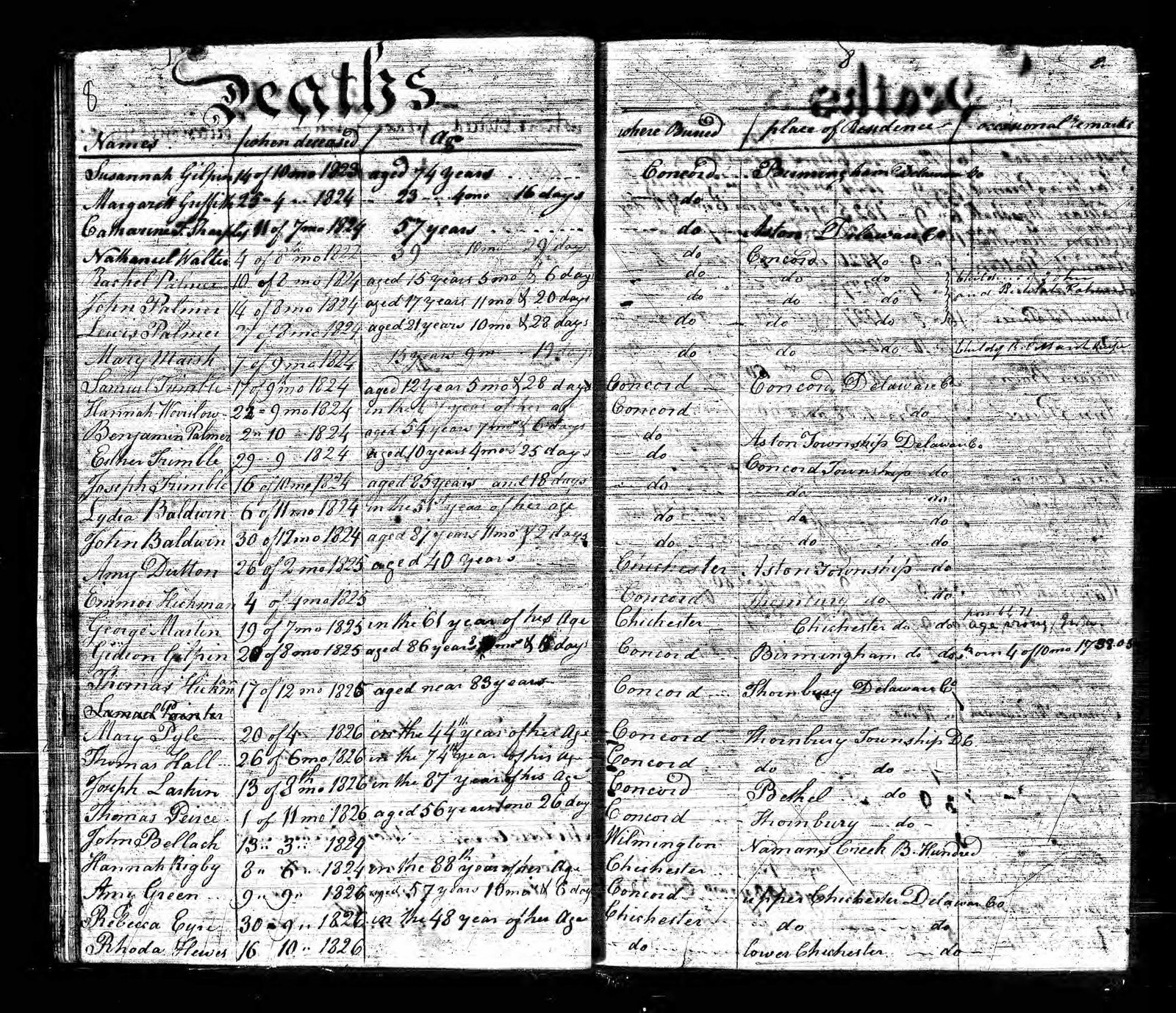
Rigby, Hannah — d. 8th of 6th mo. 1824, in her 88th year — buried Chichester
The boardStill Open
- Her birth. Not registered in the Concord book and blank on her Friends Historical Library card. If Daniel Brown’s family was received into membership rather than birthright, that would explain it.
- The marriage itself. Never found. The 1758 complaint dates it to roughly 1756–57 and tells us a clergyman performed it — but St Paul’s, Chester, the mother church of James’s parish, kept no marriage register in those decades.
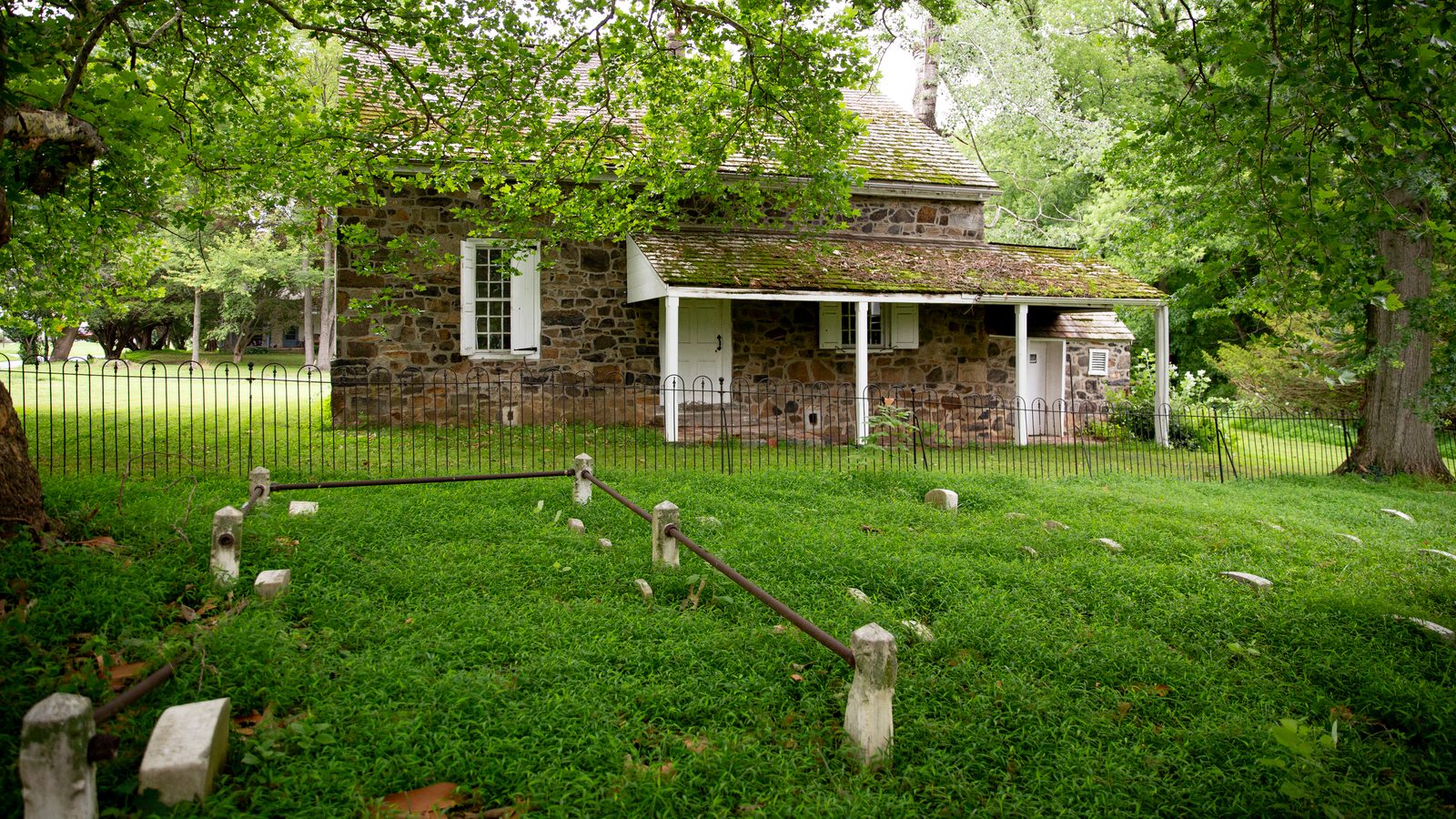
- Her stone. Over half the markers at Chichester were illegible on the 2026 visit. An 1824 stone is a long shot; her son’s 1859 one is not.
- Elizabeth Harlan’s disownment — the missing middle of the three-generation pattern.
Sources
Concord Monthly Meeting men’s minutes, pp. 14–20, and women’s minutes, pp. 52–59, 1758–59. Concord Monthly Meeting births-and-burials register, p. 8. Friends Historical Library surname card index (Swarthmore College). Will of Daniel Brown of Upper Chichester, Chester County Will Book D–E pp. 40–41, proved 12 December 1767. “Dutton Records of Deaths, Marriages, Etc. 1770–1870,” Pennsylvania Genealogical Magazine vol. 4 no. 1. Alpheus H. Harlan, History and Genealogy of the Harlan Family (1914), entry 472. Chester Monthly Meeting women’s minutes, 1829 (for Lydia John). Photographs of Chichester Friends Meeting House by Samuel Rigby, 2026.