For thirty-one years James Rigby led the responses and set the psalm at a small brick chapel on the Delaware, eight to ten miles from where he lived. He taught school in at least three townships and rented every house he lived in. The parish recorded his pew rent to the penny for four years running, and recorded neither his marriage, his children’s baptisms, nor his burial. Claims below that rest on tradition rather than record are marked, as are the things that are simply unknown.
Vital events
- Born
- Unknown. 16 April 1737, or 1731 — two traditions, neither documented. Place: England (Smedley 1901, Harlan 1914) or Pennsylvania (online trees). Unresolved. 20 21
- Married
- c.1756–57, to Hannah Brown of Upper Chichester. No record survives. Dated from the Concord Monthly Meeting complaint of 3 April 1758 and its wording, “by the Assistance of A Priest.” 4 6
- Died
- 9 March 1801. Recorded in a private Dutton family memorandum book; no place of death stated. 22
- Buried
- Unknown. No stone at St Martin’s; no entry in the Concord register; no ground-breaking entry at St Martin’s in 1801. Chichester Friends is the likeliest ground — his wife, son and daughter-in-law are all there — and is unproven. 1 5
Residences and assessments
- 1760–1791
- Lower Chichester (Marcus Hook) — parish clerk; separately assessed for a house and lot at £5 10s a year, a schoolmaster’s charge and one cow. 1 12
- c.1768–70
- Concord — listed under Inmates at 2s 6d: a married householder holding no land. 12
- undated
- Upper Chichester — tenement at £4 a year plus a schoolmaster’s charge; elsewhere a tenant of Jacob Howell at £4 10s. 12
- 1774–1800
- Aston (Village Green) — taxed 1774 and 1781; enumerated schoolmaster 1793; 5 acres 80 perches and no dwelling in 1798; head of household 1800. 12 13 14 15
- 1790
- Middletown (Lima) — head of household, four persons. 14
- Never
- Owned the ground he lived on. In no assessment is he charged for a farm or a dwelling of his own. See Places for the full table and the map.
Occupation
- Trade
- Schoolmaster. Charged a 2s 6d trade levy in both Chichesters, and enumerated as such at Aston on 1 June 1793. 12 13
- Office
- Clerk of St Martin’s Church, Marcus Hook, 9 June 1760 – 26 April 1791. A paid parish post. Still styled “Clk” on the Aston tax rate of 1781. 1 12
- Militia
- Enrolled April 1777; erased on appeal August 1777; recorded “POOR” on a further appeal, June 1779; still classed 1782. No evidence of service. 16
Religion
- Affiliation
- Anglican throughout. Established by the Quaker minute describing his marriage as performed “by the Assistance of A Priest” (1758), two years before the vestry book records him as clerk. 1 4
- Household
- Mixed. His wife was a Friend, disowned for the marriage and restored within the year; she died a member in 1824 and is buried at Chichester. Two communions in one house for the whole of the marriage. 4 5
Family
- Wife
- Hannah Brown, c.1736 – 8 June 1824, daughter of Daniel Brown of Upper Chichester. 9
- Children
- Eight named across the compiled genealogies; no baptismal register survives, so the list is a working one.
Daniel (1757–c.1845/50) · Judith (1759–1847, m. Edward Flounders) · John (1761–1845) · Rodney (b. 1763) · Seth (c.1761/64–1854, m. Hannah Clark) · Eli (1771–1859, m. Elizabeth Harlan) · Sydney (1774–1852) · Rachel (1776–1856).
⚠ Dates for five of the eight come from an unsourced family tree and are leads, not facts. And the 1790 census shows a male under sixteen in the household who matches none of them. 14 20 21 - Line
- Seventh great-grandfather of the compiler — see the line of descent.
Names
- Attested spellings
- Rigbey (1760, c.1768) · Regy (1774) · Rigby (1781, 1790, 1792, 1794) · Rigbee (1791) · Rigbe · Rigsey
- Not attested
- No middle name of any kind. The “G.” and “Guerney” found in online trees appear in no document of his lifetime.
The shape of itTimeline
Marries Hannah Brown
No record. Dated from the disciplinary case that followed.
Hannah is disowned, and restored
Concord Monthly Meeting, 3 April to 6 November. The minute naming a priest is the first evidence of his religion. The case in full →
Chosen clerk of St Martin’s
At the meeting that named the church, by the Rev. George Craig. He is twenty-three or twenty-nine. The church →
Listed among the Inmates at Concord
2s 6d. The only trace of him between 1760 and 1774, and the assessors’ own word for a landless householder.
Named in Daniel Brown’s will
“Hannah, wife of James Rigby” — the earliest document naming the couple together.
First Aston tax list
As “James Regy.”
Enrolled in the militia
6th Battalion, 7th Company — Aston’s own company.
Struck off the roll on appeal
“To be rass’d out.” Three weeks before the battle.
“Go home, children”
The guns at Chadds Ford, eight miles west. He sends the scholars home.
“James Rigby, Clk”
Aston tax rate, 7s 4d — the church office as an identifier, twenty-one years in.
Middletown, four in the house
First federal census. One of the four fits no known child.
Takes a third of pew 12
Seven and sixpence. Middle of the congregation.
Replaced as clerk
“Rich Lamplugh to Act as Clerk.” Thirty-one years.
Enumerated schoolmaster
Aston septennial census, taken 1 June by Joseph Pennell.
Last appearance in the pew roll
A five-shilling share of pew 13. After this he is gone from the rent roll.
Five acres, no house
Direct Tax, Aston: 5 acres 80 perches, sixty-six dollars, no dwelling entered.
Dies
The vestry meets four weeks later and does not mention him.
BeginningsWhere He Came From Is Not Known
Two published genealogies, working from family informants a century after his death, say he was born in England — Smedley’s Genealogy of the Sharpless Family (1901), compiled by Gilbert Cope, says he “immigrated from England”; the Harlan genealogy (1914) calls him “James Rigby (teacher), b. in England.” Online trees and FamilySearch say Pennsylvania. The year is given variously as 1731 or 16 April 1737.
None of it is documented. There is no naturalisation, no passenger entry that can be tied to him, no baptism that can be tied to him. Two Upholland, Lancashire baptisms have been looked at and neither can be connected. A single 1750 arrival indexed as “James Rigbey” traces back to a printed list of emigrants sailing from Irish ports, not English ones — and may itself be the source of the family’s “came over in 1750” tradition rather than evidence for it.
He appears in the American record, fully formed and already trusted with parish office, in June 1760.
Some trees and a Find A Grave memorial give him the middle name “Guerney”, or the initial “G.” No document of his lifetime gives him any middle name at all — not the tax rolls, not the censuses, not thirty-one years of vestry minutes, not his father-in-law’s will. Middle names were rare in his generation. There was a real James G. Rigby, but he was a great-grandson living in New Castle, Lawrence County, in the 1870s — and the likeliest explanation is that the initial travelled backwards up somebody’s tree.
c. 1756–57Hannah Brown
He married Hannah Brown, daughter of Daniel Brown of Upper Chichester. There is no marriage record — but there is something almost as good: the record of her being punished for it.
Hannah was a Quaker. On 3 April 1758 Concord Monthly Meeting disowned her for marrying out of unity, “by the Assistance of A Priest” — which is how a Friends minute describes a wedding performed by a clergyman. The phrase is itself evidence about him: he was Anglican. On 6 November 1758 she offered an acknowledgment and was restored, and she died a member sixty-six years later.
Her father’s will, made in 1767 and proved that December, names “Hannah, wife of James Rigby.” It is the earliest document in which the two of them appear together, and it disposes of a claim in the old county history that his wife was “probably Rachel” — Rachel was Daniel Brown’s granddaughter, who married John Dutton.
Hannah outlived him by twenty-three years. She died 8 June 1824, aged 88, and was buried at Chichester Friends burying ground, where the meeting’s own register records her. Their household straddled two communions for the whole of the marriage: he served an Anglican altar; she was buried among Friends.
9 June 1760Clerk of St Martin’s
The ground the church stands on was a gift. Walter Martin of Upper Chichester, by a deed of 18 December 1699, gave Lower Chichester one acre “for a Church & Burying Ground.” The congregation was poor; for years it had no building, then bought an old wooden frame house for about five pounds — “a great Sum in those Days” — hauled it onto Martin’s acre and fitted it up for worship. A brick church was subscribed for from 1745.
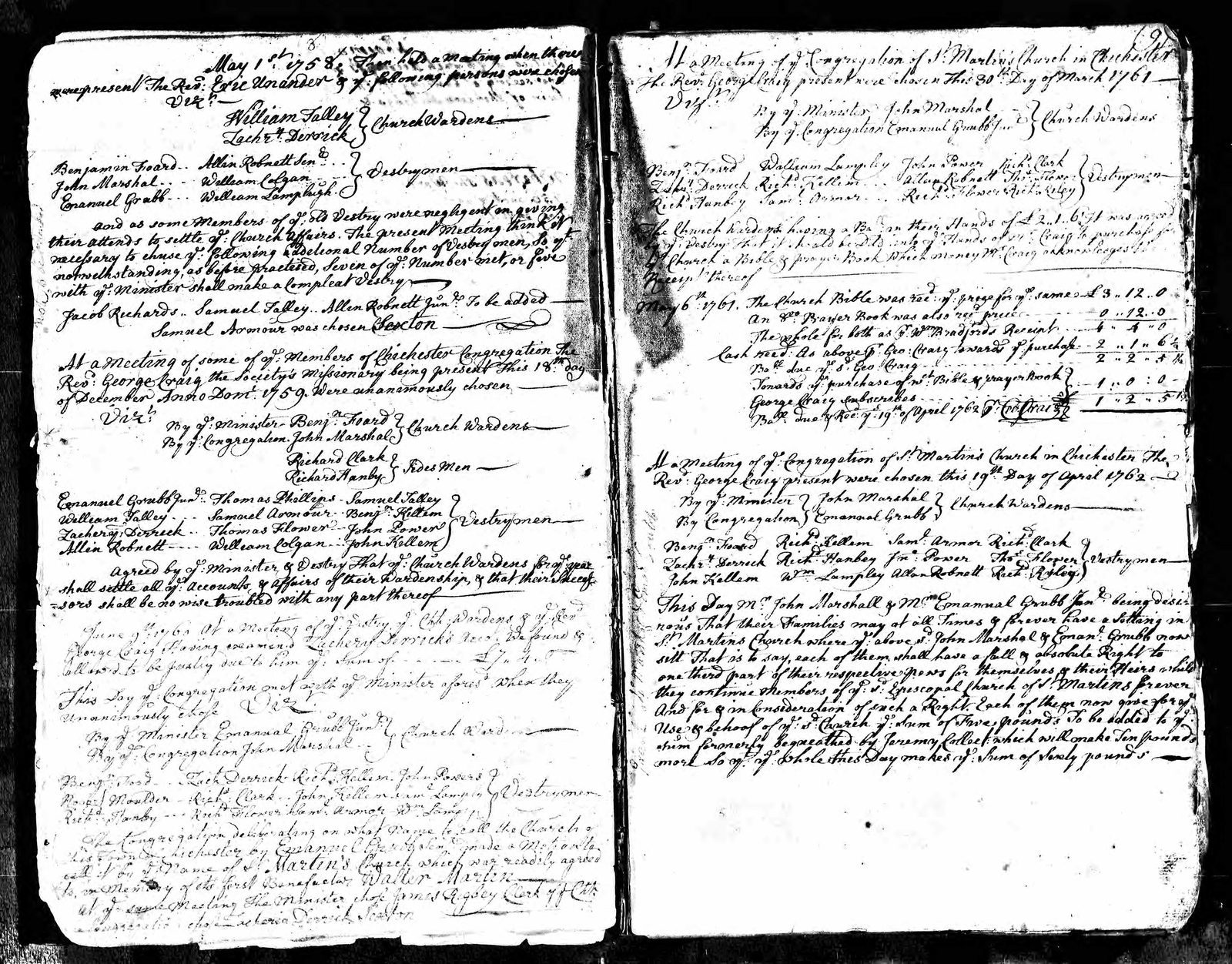
On 9 June 1760 the vestry and congregation met with the Rev. George Craig, the Society for the Propagation of the Gospel’s missionary, present. They audited the sexton’s accounts, chose churchwardens, and named twelve vestrymen. Then two things happened in the same sitting.
First, the congregation gave the church its name: Emanuel Grubb Senior moved that it be called St Martin’s Church, in memory of its first benefactor Walter Martin, “which was readily agreed to.” And then, in the very next line of the minute:
At ye same Meeting The Minister chose James Rigbey, Clark of ye Chh. Vestry book, St Martin’s Church, Marcus Hook · 9 June 1760
James Rigby was made clerk of St Martin’s at the meeting that made it St Martin’s. He was young for it — twenty-three if he was born in 1737, twenty-nine if in 1731.
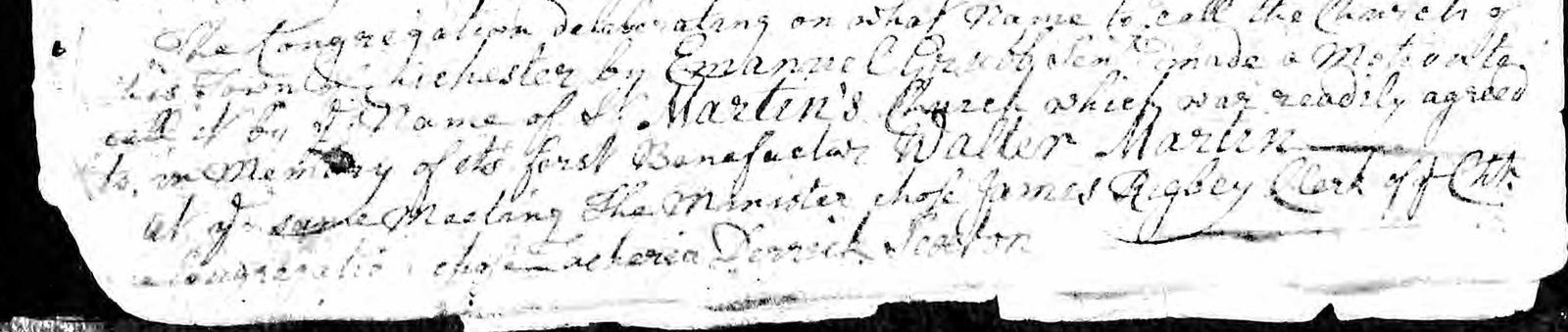
The Congregation deliberating on what Name to call the Church of this Town of Chichester, by Emanuel Grubb Senr made a Motion to call it by ye Name of St. Martin’s Church which was readily agreed to, in Memory of its first Benefactor Walter Martin. At ye same Meeting The Minister chose James Rigbey, Clark of ye Ch[urch]. ye Congregatio[n] chose Zacharia Derrick, Sexton.
The vestry recorded the clerkship only when it changed hands, which is why the office appears in the book exactly twice. The next clerk named anywhere in the volume is at the meeting of 26 April 1791: “Rich Lamplugh to Act as Clerk.” Nothing falls between.
So he was clerk of St Martin’s from 9 June 1760 to 26 April 1791 — about thirty-one years. The span is corroborated from outside the parish, in another jurisdiction, halfway through: the Aston township tax rate of 1781 lists him as “James Rigby, Clk,” assessed 7s 4d. Twenty-one years into the term, the church office was attached to his name as an identifier by men collecting county taxes.
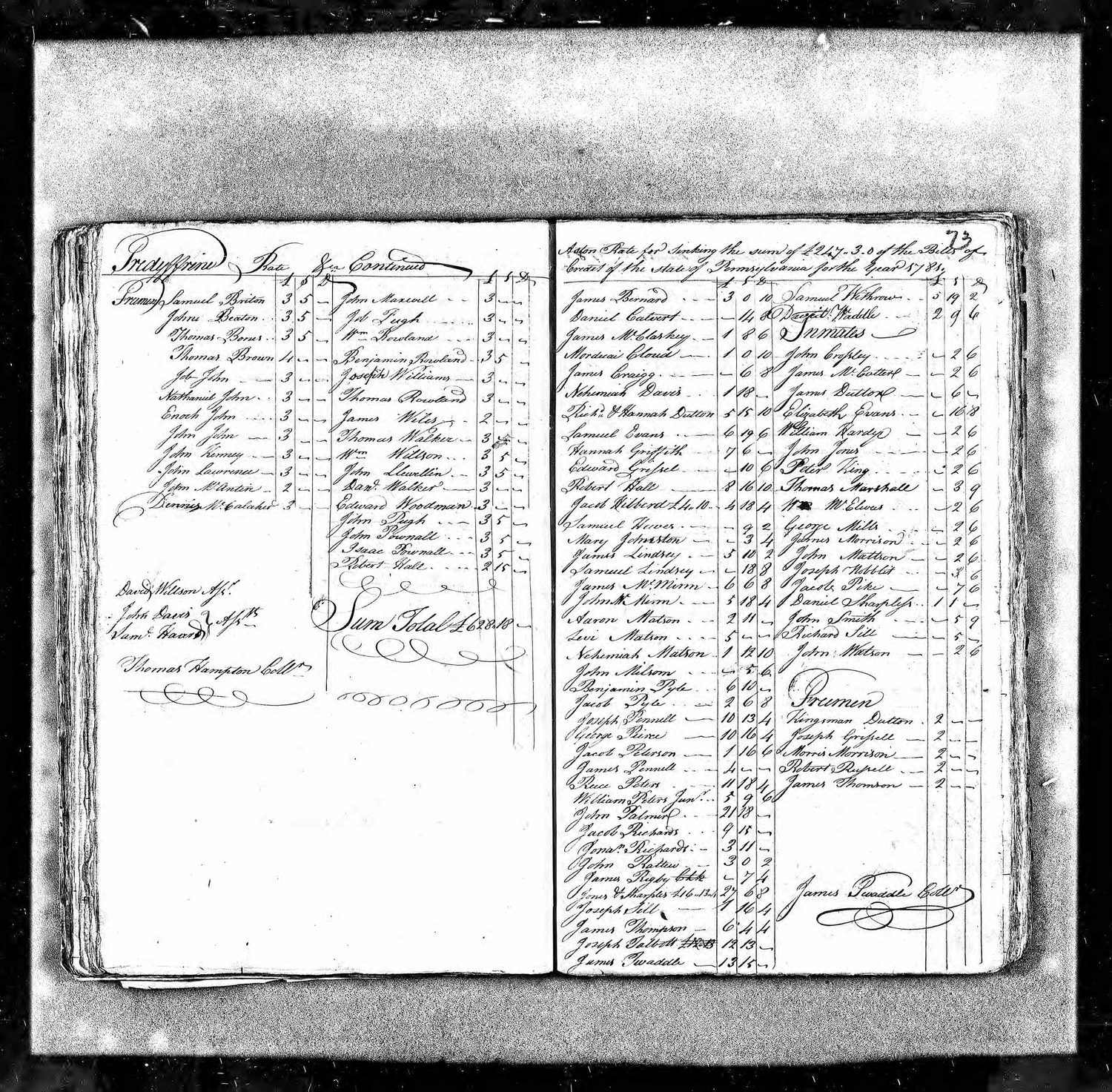
The Aston township rate for 1781. “James Rigby, Clk” — 7s 4d. Around him on the same sheet are Richard and Hannah Dutton and James McClaskey.
He did not live at Marcus Hook. Every record that places him places him inland — Aston, Middletown, the Chichesters — roughly eight to ten miles from the Hook. For three decades he was travelling to hold this office.
James Rigby, Clk — 7. 4
1790–1794His Seat in the Church
St Martin’s rated its pews annually and wrote every shareholder’s name in the book. James Rigby appears in four of those ratings, and each has been read directly against the page image.
At the rating of 3 July 1790 the twelfth line reads “James Rigby ⅓ — 7/6”; the pew’s full rate was £1 2s 6d and the other two thirds are bracketed to Andray McEntere and John Prence. On 26 April 1791 — the same meeting that replaced him as clerk — pew 12 is shared by Samuel Walker, “James Rigbee ⅓” and Thomas Wallace at £1 5s. On 10 April 1792, pew 12: “Thos Wallis ⅓, James Rigby ⅓” at £1 2s 6d. And on 22 April 1794 he has moved to pew 13, at a five-shilling share alongside George Mitchell and Jacob Burns.
Pew rents ran from £1 10s at pew 1 down to about twelve and sixpence at the back, with half a crown for the bench at pew 24. A third of pew 12 at seven and six put him squarely in the middle of the congregation — not among the Grubbs and Marshalls at the front, not on the bench.
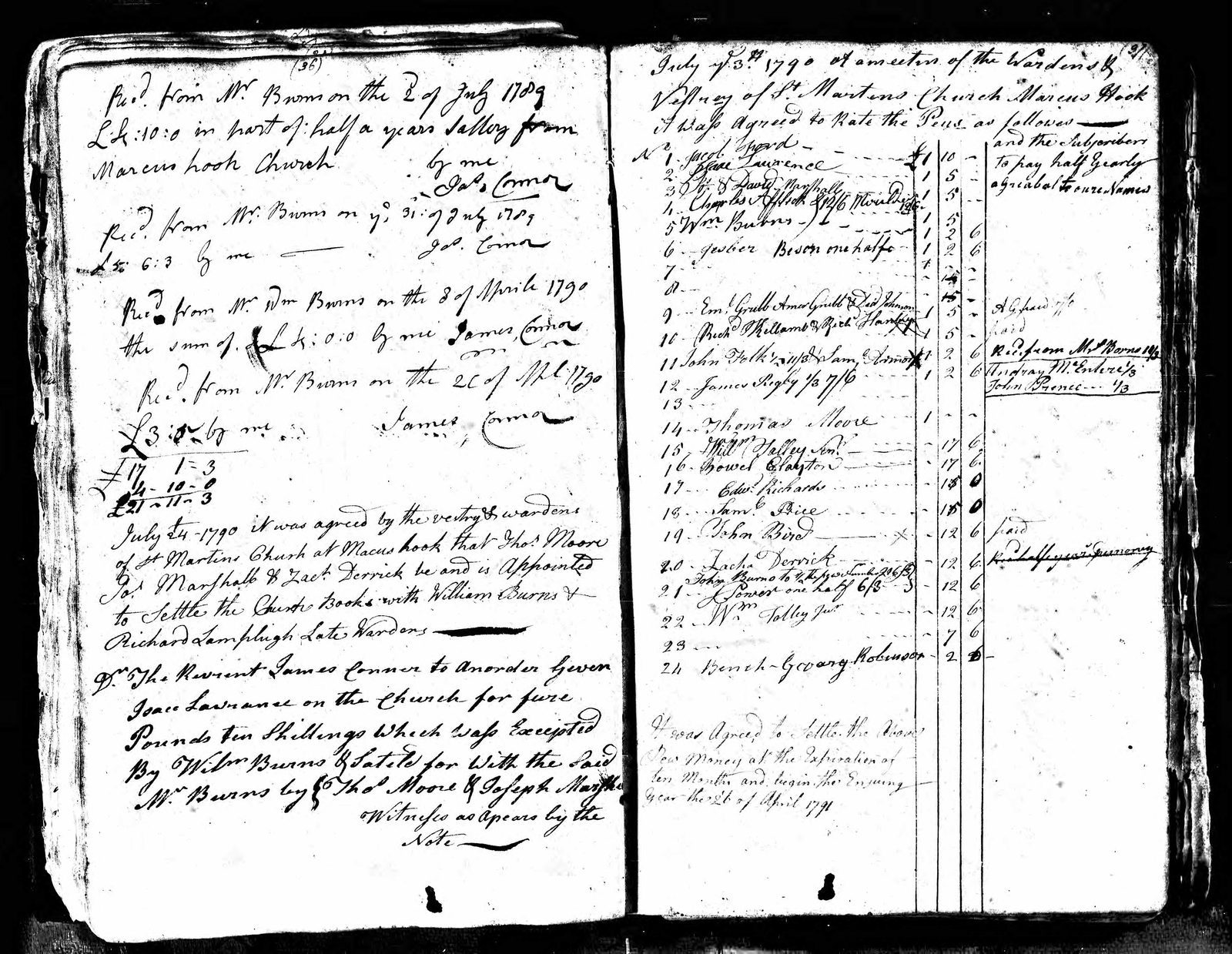
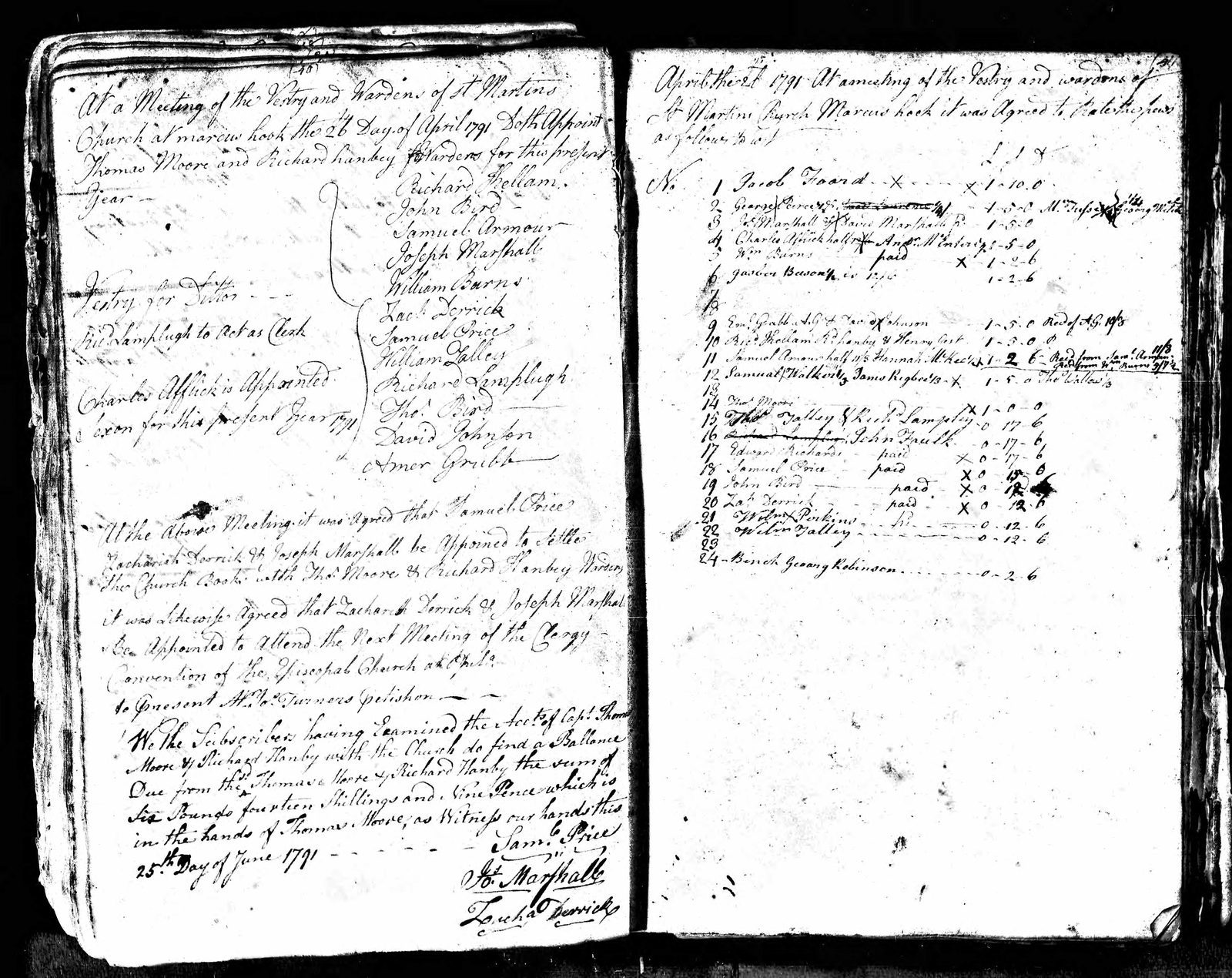
3 July 1790 — “at a meeting of the Wardens & Vestrey of St Martens Church Marcus Hook it was Agreed to Rate the Pews as followes” 12 James Rigby ⅓ 7/6 — with Andray McEntere and John Prence; pew total £1 2s 6d 26 April 1791 — “April the 26th 1791 At a meeting of the Vestry and wardens of St Martins Church Marcus hook it was Agreed to Rate the pews as follows to wit” 12 Samuel Walker ⅓ James Rigbee ⅓ ✕ 1–5–0 Tho. Wallace ⅓ 10 April 1792 — “At the meeting of the vestry and wardens for St Martins Church April 10 1792 it was agreed to Rate the pews as follows viz” 12 Thos Wallis ⅓ James Rigby ⅓ 1–2–6 22 April 1794 — “At a meeting of the wardens and Vestry of St Martins Church Marcus Hook April 22, 1794 it was Agreed to Rate the Pews as follows” 13 Gorge Mitchell 7/6 paid Jacob Burns ⟦6/8⟧ J⟦a⟧s Rigby 5/– 1–0–0
He kept his seat about three years after losing the office, then let it go. Pew 12 was re-let; by the ratings of 1801 and 1802, pews 11, 12 and 13 all stood empty. He was alive until 1801, so this is age, money or distance — not death.
His tradeThe Schoolmaster
The county history says he “taught school in Chichester and Aston townships.” That is now documented on paper, in both Chichesters, in the assessors’ own hand.
An Upper Chichester rate charges him for a tenement at £4 a year — 3s 7d, and then adds a second line: “& Schoolmaster — 2s 6d.” Total six shillings. No acreage, no livestock, no servants: a landless man with a trade charge. A Lower Chichester rate — that is, Marcus Hook, the township where he was parish clerk — has him at a house and lot at £5 10s, plus “Schoolmaster with 1 Cow — 2s 6d.” Total seven and six.
And in the septennial enumeration of Aston taken 1 June 1793 by Joseph Pennell, a state census of taxable inhabitants, his occupation is written out beside his name: schoolmaster. He was then in his late fifties or early sixties and still teaching.
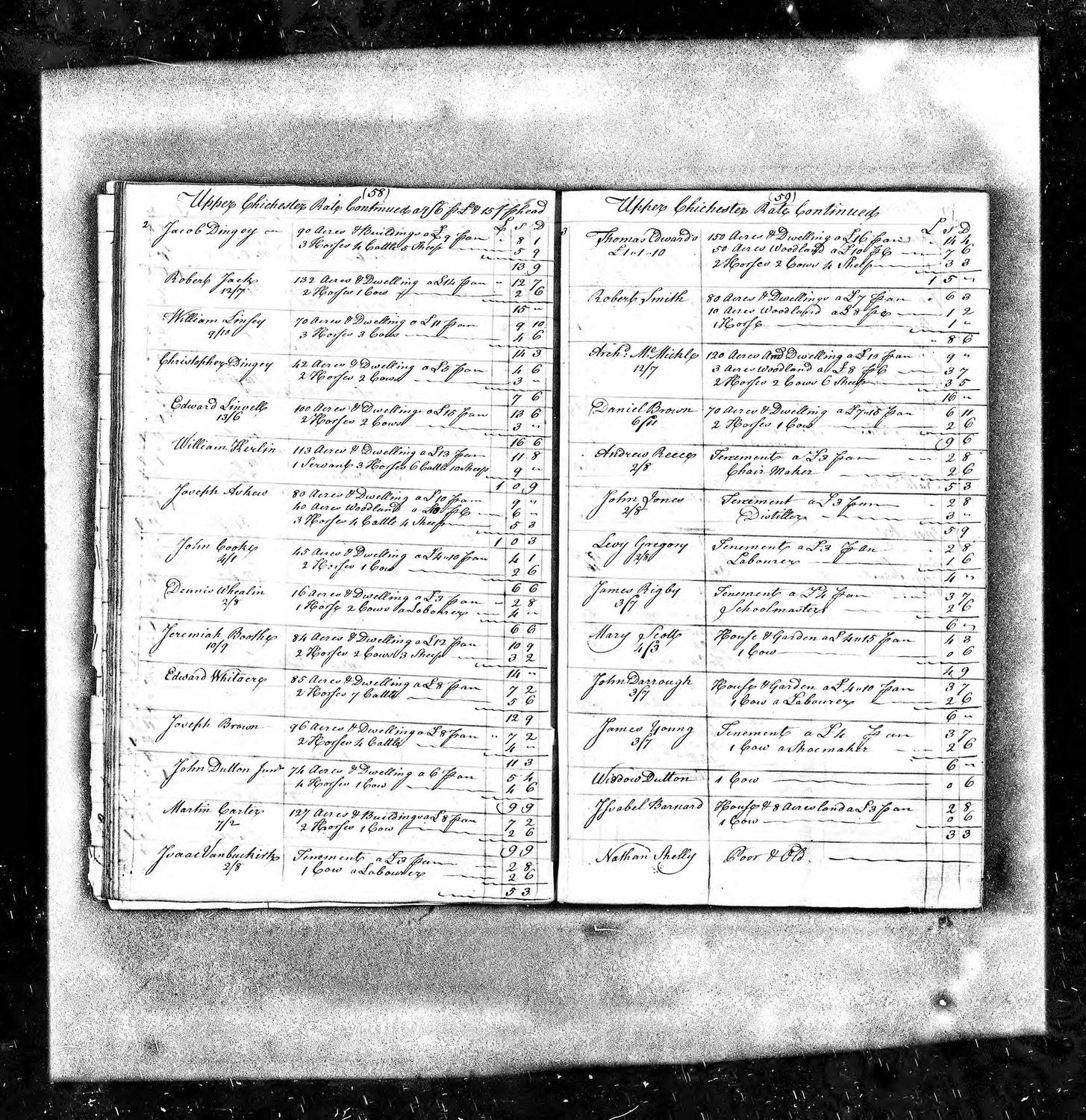
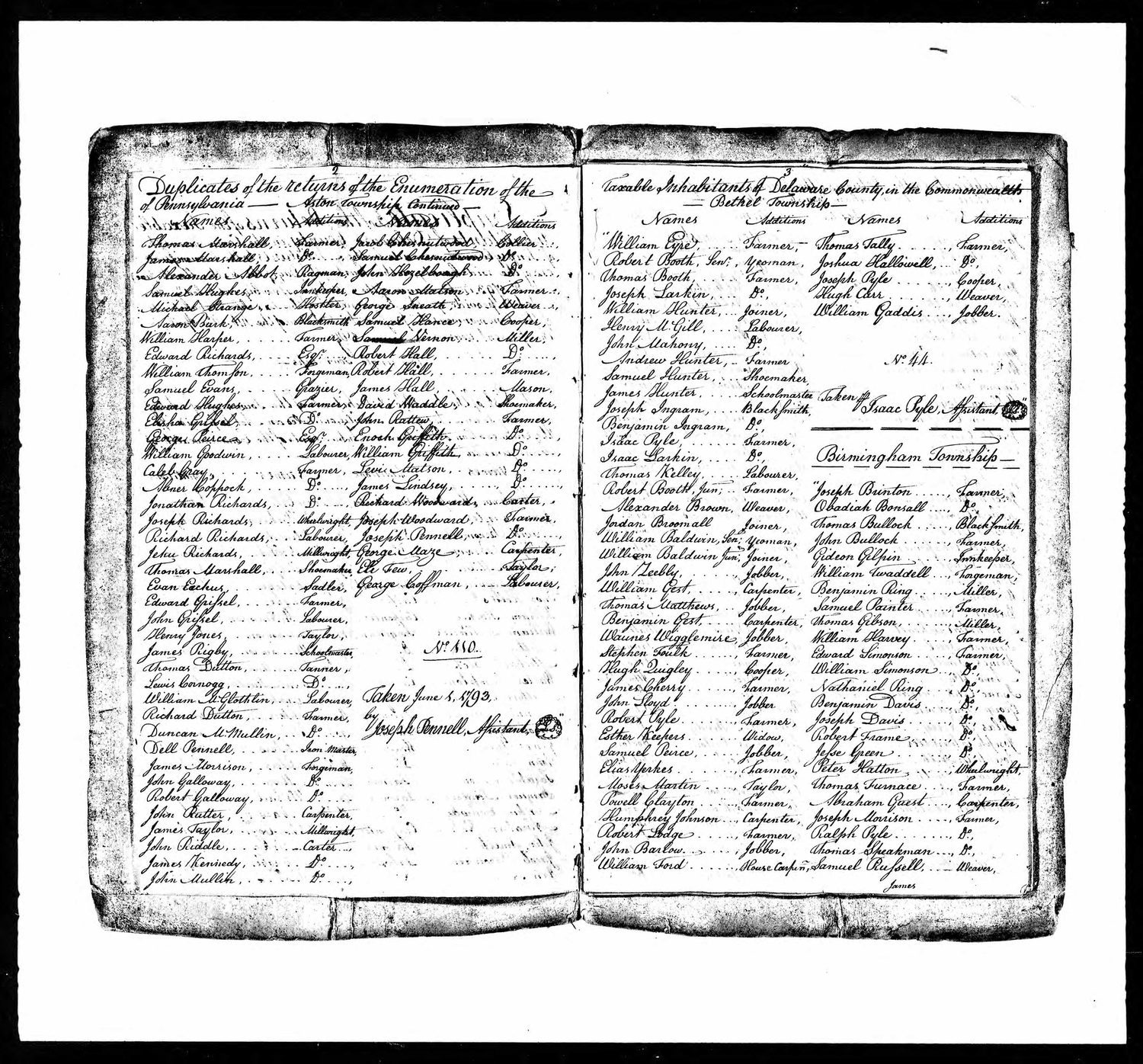
Upper Chichester rate (undated) James Rigby Tenement at £4 per annum ......... 3. 7 & Schoolmaster .................. 2. 6 Total 6. 0 Lower Chichester rate (undated) James Rigby House & Lot at £5.10 per annum ... 4. 11 Schoolmaster with 1 Cow ......... 2. 6 Total 7. 6
11 September 1777“Go Home, Children”
The story comes from Thomas Dutton, who was eight years old that morning. He was born 2 February 1769 and died 12 September 1869, aged one hundred years, seven months and eleven days, and told it for most of that time:
The pupils had assembled at the school as usual, but when the booming of the cannon at Chad’s Ford, but a few miles distant, was heard, the aged master, James Rigby, dismissed the scholars, saying, “Go home, children; I can’t keep school to-day.” Thomas Dutton’s recollection, printed in Ashmead, History of Delaware County (1884), p. 298
Schools.—The history of schools in Aston is interesting, and can be traced in our annals certainly to the year 1777, for Thomas Dutton used to relate that the day of the battle of Brandywine—he was then nine years of age—the pupils had assembled at the school as usual, but when the booming of the cannon at Chad’s Ford, but a few miles distant, was heard, the aged master, James Rigby, dismissed the scholars, saying, “Go home, children; I can’t keep school to-day.” After the English troops had withdrawn from the neighborhood of Village Green, doubtless the school resumed its sessions; but of that fact we have no positive evidence. The presumption is, however, that at the beginning of this century no building especially designed for school purposes had been erected in that township. This fact seems to be established from the deed dated May 11, 1802, by which Samuel Hewes, of Aston, conveyed to William Pennell and Thomas Dutton, of the same township, “for the use of a school, a house thereon to be built,” a lot of land comprising an acre, which was part of a tract of fifty-nine acres which Thomas Goodwin had sold, Nov. 1, 1799, to Hewes.
A newspaper feature of 25 July 1899, drawing on local tradition, adds detail: a fog thick enough to shut out the landscape; the master “appeared depressed, and with difficulty could follow the mumbling scholars”; the fog lifting shortly after ten o’clock, when Proctor’s artillery opened on Knyphausen across the creek.
Village Green lies about eight miles east of Chadds Ford.
Two days later Lord Cornwallis quartered at the Seven Stars tavern at Village Green and British and Hessian troops camped from Mount Hope down through the lower village. Young Dutton drove his mother’s cattle off to keep the soldiers from killing them, and an officer walked him home and told the widow to bolt and bar every door, because the camp-followers would plunder the house.
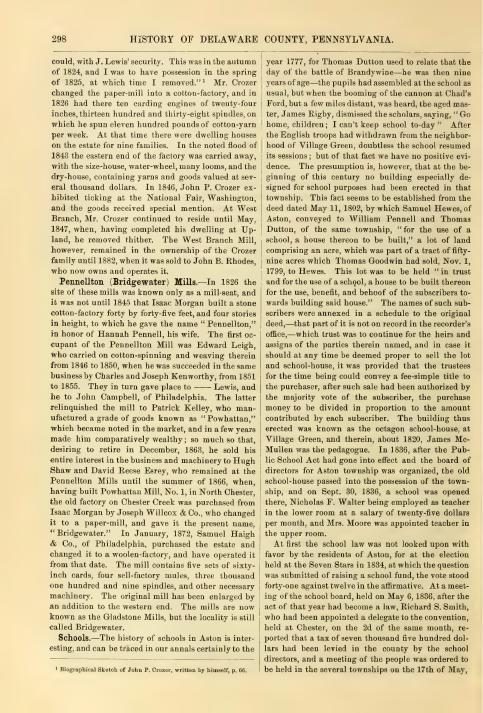
He was not teaching in the octagon school-house. That building — Aston’s first purpose-built schoolhouse, at Village Green — was erected for subscribers after a deed of 11 May 1802, by which Samuel Hewes conveyed an acre to William Pennell and Thomas Dutton “for the use of a school, a house thereon to be built.” James Rigby died fourteen months before that deed. Ashmead says plainly that at the beginning of the century no building especially designed for school purposes had been erected in that township. So in 1777 the school met in an ordinary room somewhere at or near Village Green — and which one is genuinely unknown.
And Dutton was eight, not nine. Born 2 February 1769, he was eight and seven months on the day of the battle. The 1899 feature has it right; the county history is a year out.
Dutton called him “the aged master.” On the 1737 birth date he was forty that morning; on the 1731 date, forty-six. An eight-year-old may simply have thought forty was old, but the phrase is mild evidence for the earlier date, and it is the only description of his appearance on record.
1777–1782The War, and the Word “Poor”
Four Chester County Lieutenancy cards survive for him. Read together they are not a service record. They are an exemption record.
He was enrolled on a company return of 18 April 1777, in the 6th Battalion’s 7th Company — which the county’s own militia map identifies as Aston township’s company. Four months later, on 22 August 1777, a card in Captain James Thompson’s company carries the remark “to be rass’d out” under the authority “appeal.” He had gone to the county and got himself struck off the rolls. Three weeks later the battle came down the road to his schoolhouse.
And then, on 7 June 1779, in the Ashtown company of the 6th Battalion under Colonel Thomas Taylor, fourth class, there is a card whose Remarks column holds a single word and whose Authority column names the book it was taken from:
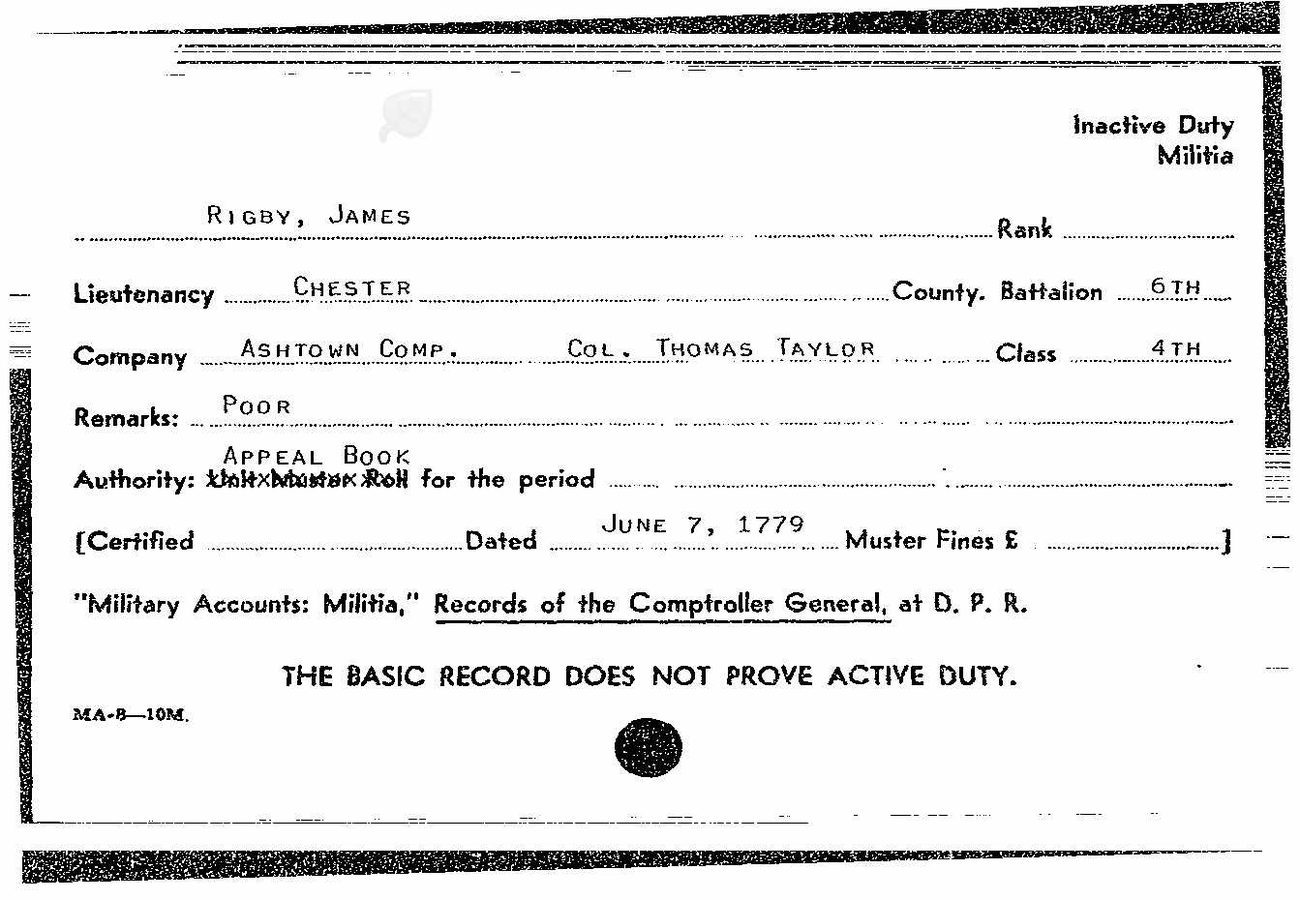
RIGBY, JAMES · 6th Bn, Ashtown Comp., Col. Thomas Taylor, 4th Class · Remarks: POOR · Authority: APPEAL BOOK.
Every other statement of his means in this project is an inference — drawn from what he was not charged for. This is the opposite: an affirmative finding, made by the county government, in a proceeding where the man himself appeared and pleaded. Poverty was a recognised ground of exemption. He claimed it and it was allowed.
A last card, a class return of 25 November 1782, still has him being classed in the 6th Battalion’s second company. Nothing in the file shows him serving.
RIGBY, JAMES CHESTER LIEUTENANCY · 6TH BN. · CAPT. JAMES THOMPSON’S COMPANY REMARKS: TO BE RASS’D OUT AUTHORITY: APPEAL AUG. 22, 1777 RIGBY, JAMES 6TH BN. · ASHTOWN COMP., COL. THOMAS TAYLOR · 4TH CLASS REMARKS: POOR AUTHORITY: APPEAL BOOK JUNE 7, 1779 RIGBY, JAMES 6TH BN. · 2ND CO. · 4TH CLASS CLASS RETURN NOV. 25, 1782 published PA Archives, 5th ser. V, 755–56
The tax rollsA Landless Life, in Seven Townships
The parish books record his office. The tax lists record his circumstances.
In not one assessment does he own the farm he lives on. He rents a tenement at £4 a year here; a house and lot at £5 10s there; he is a tenant of Jacob Howell at £4 10s somewhere else. He keeps a cow, sometimes a horse. The only ground he is ever recorded as owning outright is a village lot in Aston — five acres and eighty perches, valued at sixty-six dollars in 1798, with no dwelling house on it.
And in a Concord rate of about 1768–1770 the assessors used their own word for what he was.
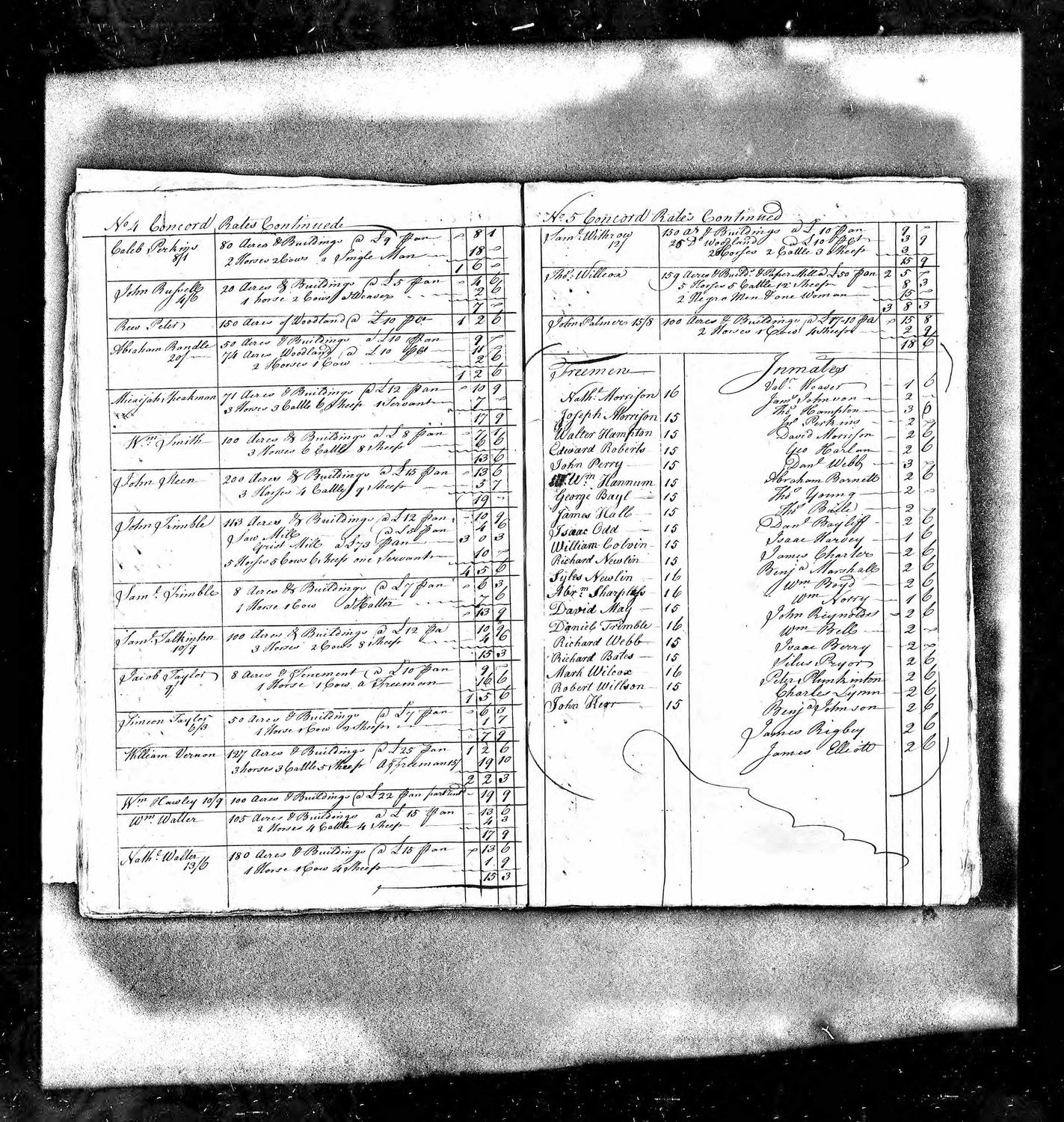
Inmates Vale Weaver ......... 1 6 Jams Johnson ........ 2 – Thos Hampton ........ 3 6 Jno Perkins ......... 2 6 David Morrison ...... 2 6 Geo Harlan .......... 2 6 Danl Webb ........... 3 6 Abraham Barnett ..... 2 6 Thos Young .......... 2 – Thos Ball ........... 2 – Danl Bayliff ....... 2 6 Isaac Harvey ........ 1 6 James Charter ....... 2 6 Benja Marshall ..... 2 6 Wm Boyd ............ 2 6 Wm Norry ........... 1 6 John Reynolds ....... 2 6 Wm Bell ............ 2 – Isaac Berry ......... 2 – Silus Pryor ......... 2 6 Peter Plunkinton .... 2 6 Charles Lymn ........ 2 6 Benja Johnson ...... 2 6 James Rigbey ........ 2 6 James Elliott ....... 2 6
“Inmate” is an assessment term, unrelated to the modern sense. In eighteenth-century Pennsylvania it means a married householder who owns no land — a man with a family, renting, charged a flat low rate. The paired category, Freeman, means a single man of taxable age. Every other record leaves his tenancy to be inferred; this one names it.
It is also the only trace of him between the clerkship of 1760 and the Aston tax list of 1774, and it places the family in Concord — the township of Hannah’s own monthly meeting.
| Year | Place | What it says | Source |
|---|---|---|---|
| 1760–1791 | Lower Chichester (Marcus Hook) | Clerk of St Martin’s Church | Parish vestry book |
| c.1768–70 | Concord | Listed under Inmates, 2s 6d | Chester Co. rate |
| undated | Upper Chichester | Tenement £4 + Schoolmaster | Chester Co. rate |
| undated | Lower Chichester | House & lot £5 10s + Schoolmaster with 1 cow | Chester Co. rate |
| 1774 | Aston | “James Regy” | Aston tax list |
| 1777–1782 | Aston / Concord | Militia enrolment, two appeals, class return | Chester Co. Lieutenancy |
| 1781 | Aston | “James Rigby, Clk” — 7s 4d | Aston rate |
| 1790 | Middletown | Head of household — 4 persons | U.S. census |
| 1793 | Aston | Schoolmaster | Septennial enumeration |
| 1798 | Aston | Owner, 5 acres 80 perches, $66, no dwelling | U.S. Direct Tax |
| 1800 | Aston | Head of household | U.S. census |
There was another James Rigby in Delaware County at the same time. The 1800 septennial list of Marple taxables names a James Rigbey in the same year the federal census enumerates ours in Aston; one man cannot be both. A separate household — Marple, Newtown, probably Edgmont, with a Daniel Rigby alongside it from about 1787 — runs through the same decades. Records from that northern cluster are deliberately excluded here, including a well-described stone house that was for one morning very tempting to claim.
The Marple sheet, as headed and signed: “A List of the Taxable Inhabitants of Marple taken in 1800” … James Rigbey … “Total Number 128” Philip Moore, Assr · Delaware County ss · A Copy Certified · Isaac Gilpin, Thos Bishop, Thos Vernon, Commrs
The householdHis Children
No single source lists them and no baptismal register survives. Eight children are named across the compiled genealogies and family trees: Daniel (1757–c.1845/50, who went west to Ohio and whose estate was partitioned in Jay County, Indiana), Judith (married Edward Flounders), John, Rodney, Seth (c.1761–1854, who married Hannah Clark at the First Presbyterian Church in Philadelphia in 1790 and died at New Castle, Lawrence County, aged ninety-three), Eli (1771–1859), Sydney and Rachel.
Only Eli, Seth, Daniel and Hannah’s parentage rest on documents. The rest is compiled genealogy and should be treated as a working list rather than a finished one.
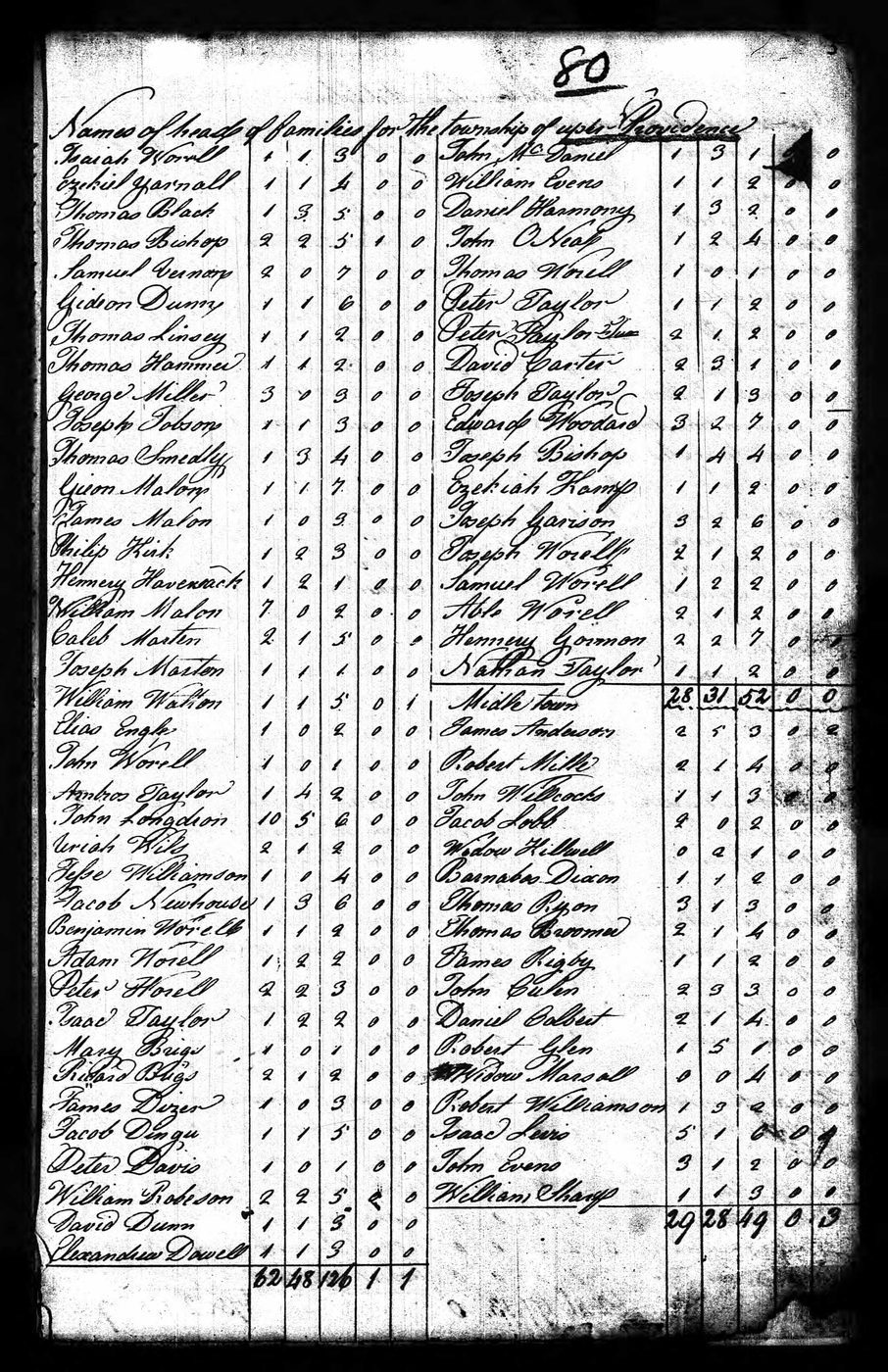
The first federal census, Middletown township, page 80: James Rigby — one free white male of 16 and upward, one under 16, two females. Four people in the house, between Thomas Broomer and John Culen.
And there is a puzzle in it. A boy under sixteen means someone born in 1775 or later. Eli was nineteen; Rachel, the youngest of the eight, was born in 1776 and was a daughter. No known child fits. A grandson, an apprentice, or — in a schoolmaster’s house — a boarding scholar are all likelier than a ninth child. But somebody was living there, and we do not know who.
Free white males Free white males Free white All other Slaves of 16 years and under 16 years females free upward, incl. heads Thomas Broomer ................ 1 2 3 – – James Rigby ................... 1 1 2 – – John Culen ..................... 1 1 4 – –
9 March 1801The Grave That Has Not Been Found
He died on 9 March 1801. The date comes from a private family memorandum book kept in the Dutton household, copied out by Gilbert Cope in 1872 and later printed. Two Rigby entries appear in its seventy-eight pages: James in 1801 and Hannah in 1824.
The vestry of St Martin’s met on 7 April 1801, four weeks after his death, and did not mention him.
Where he is buried is not known. Two things explain why no record of it survives.
There was no register to be entered in
St Martin’s was never an independent parish in his lifetime. It was a chapel of ease; the mother church was St Paul’s, Chester, whose rector rode down to the Hook. A visiting minister entered his baptisms, marriages and burials in his own church’s book — which is why a vestry book running from 1724 records pews, fences and lotteries for eighty years and not one baptism.
But St Paul’s was not keeping those registers either. Its book contains a leaf ruled and headed “Marriages for ye year 1740” and left entirely blank, and another headed “Burials for ye year 1738” and left entirely blank. The established runs are: burials 1704–1708, then nothing until 1853; marriages 1705/6–1714 and 1728–1730, then nothing until 1818; christenings 1704–13 and 1728–43, a fragment at 1780–91, then 1817. No baptism, marriage or burial entry of any kind survives there between 1745 and 1800.
So his marriage in about 1756 and his burial in 1801 were never entered, because for half a century the parish was not keeping these registers at all.
And a member’s grave cost nothing
The parish did charge for burials, and named receipts survive: five shillings silver for breaking the ground for a stranger — “for the body of Henerey Rice,” 12 August 1782. But on 18 April 1797 the vestry resolved “that no Member of this Church Shall pay anny thing for brakeing Ground,” strangers to pay seven and six. After that a member’s grave produced no receipt, and the burial money was entered in lump sums — ten dollars from Zachariah Derrick covering four years at once. There is no ground-breaking entry of any kind in 1801. The absence of a receipt is therefore not evidence that he lies elsewhere.
One book has not been found
On 11 February 1831 the Rev. R. U. Morgan, rector of St Paul’s Chester in connection with St Martin’s Marcus Hook, wrote on the index leaf of his register:
There is a Registry belonging to St Martin’s church, Marcus Hook, in which several marriages, Baptisms and Burials are recorded. Rev. R. U. Morgan · 11 February 1831
That volume has not been located. If any record of James Rigby’s marriage, his children’s baptisms or his burial survives anywhere, it is in that book.
The boardWhat We Still Do Not Know
- Where he was born, and when. England or Pennsylvania; 1731 or 1737. Two published genealogies say England and neither cites anything.
- Where he is buried. Chichester Friends is the best candidate. A return visit hunting stones, and the Morgan registry if it can be found, are the two live routes.
- Morgan’s St Martin’s registry. Attested in writing in 1831 and unlocated since. The single largest unclaimed prize in this line.
- Which room he taught in on 11 September 1777. Not the octagon school-house, which post-dates him. Ashmead says no purpose-built schoolhouse existed in Aston before 1802.
- Who the boy under sixteen was in the 1790 census household.
- The Chester County appeal book. The militia cards are twentieth-century abstracts of a bound register that may carry his plea in the clerk’s own words.
- “James, son of Rigby,” Lower Chichester, 29 August 1775 — a servant with a broken contract, in a Chester County indenture packet. No son named James appears in any list of his children. The original would name the master, the term, and the father.
- The second James Rigby of Marple and Newtown — a separate household whose records need pulling apart from his, one sheet at a time.
Chosen clerk of St Martin’s on 9 June 1760, at the meeting that named the church, and replaced on 26 April 1791 — about thirty-one years, travelling eight or ten miles each way. Assessed as a schoolmaster in Upper and Lower Chichester and enumerated as one in Aston in 1793. Listed among the Inmates at Concord in about 1768. Struck off the militia roll on appeal in August 1777; recorded as poor in the county appeal book in June 1779. Held a third of pew 12 from 1790 to 1792 and a share of pew 13 in 1794. Died 9 March 1801.
Sources
Vestry book and pew accounts of St Martin’s Church, Marcus Hook, 1724–1824 (Historical Society of Pennsylvania film, Ancestry coll. 2451). Registers and accounts of St Paul’s Church, Chester. Chester County tax and exoneration records, 1768–1801; Concord, Upper Chichester, Lower Chichester, Aston and Marple rates. Chester County Lieutenancy militia cards, 1777–1782. Pennsylvania septennial censuses of 1793 and 1800. U.S. censuses of 1790 and 1800; U.S. Direct Tax of 1798. Will of Daniel Brown of Upper Chichester, 1767. Concord Monthly Meeting minutes and register, and the Friends Historical Library surname card index. “Dutton Records of Deaths, Marriages, Etc. 1770–1870,” Pennsylvania Genealogical Magazine vol. 4 no. 1. Henry Graham Ashmead, History of Delaware County, Pennsylvania (1884), pp. 296–300. Gilbert Cope, Genealogy of the Sharpless Family (1901). Alpheus H. Harlan, History and Genealogy of the Harlan Family (1914), entry 472. Newspaper feature on the Seven Stars tavern, 25 July 1899 (publication unidentified).
Every manuscript image on this page has been read against the original scan. Statements resting on compiled genealogy, family tradition or a single late witness are marked in the text.
Transcriptions follow the original spelling, capitalisation and abbreviation. Square brackets mark an editorial expansion; ⟦angle brackets⟧ mark text that is illegible or damaged. Nothing is silently modernised, and nothing is supplied by guesswork.