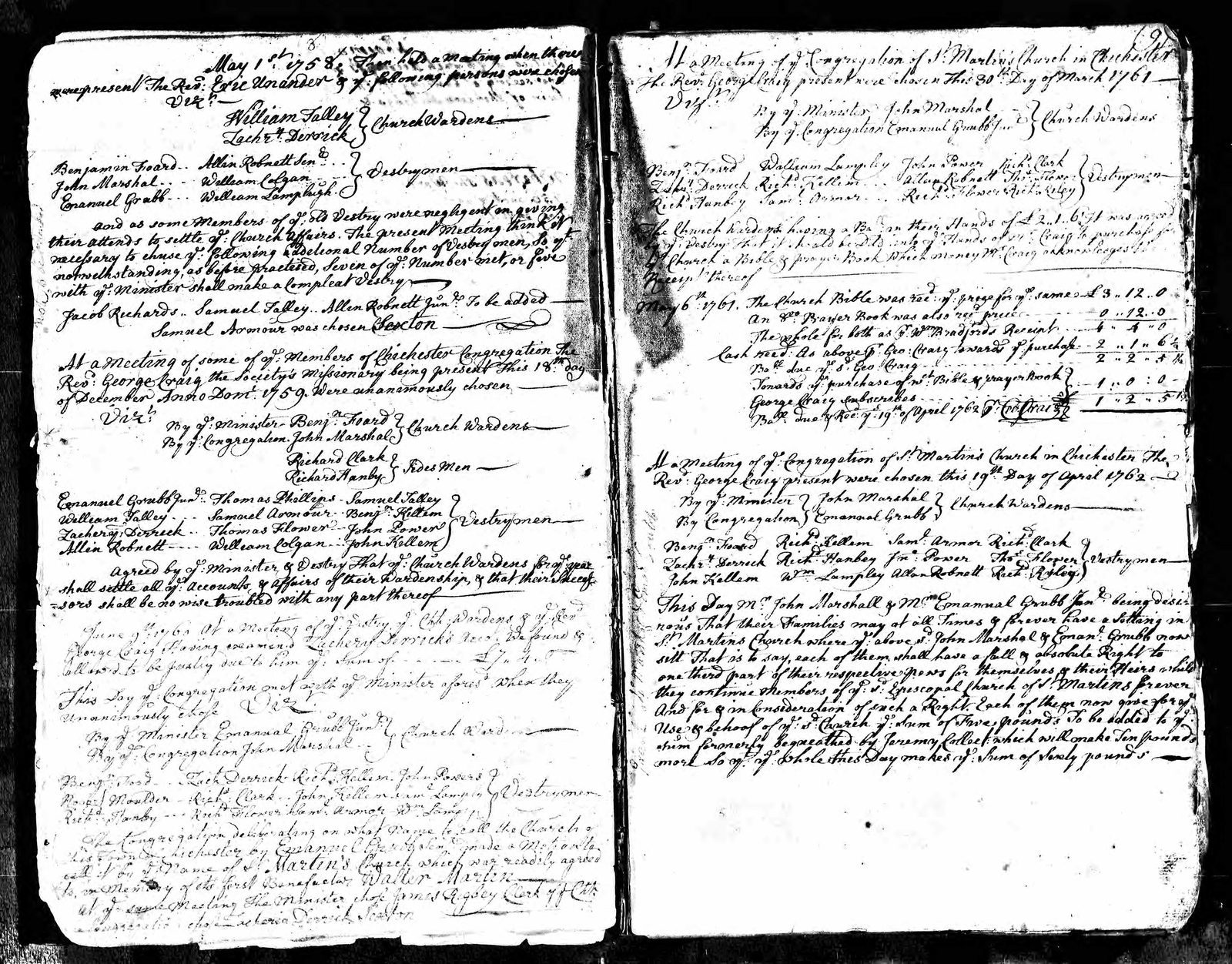
St Martin’s vestry book, kept from 1724 into the 1820s, is the main source for this family’s earliest generation. It records officers, salaries, subscriptions, repairs, burial fees and the annual pew ratings — down to which third of which pew a man held in 1792. It contains no baptisms, marriages or burials.
1699–1745The Acre, and the House They Dragged Onto It
The ground was a gift. Walter Martin of Upper Chichester, by a deed dated 18 December 1699, gave Lower Chichester one acre “for a Church & Burying Ground.”
For some years afterwards the congregation had the land and no building. Eventually the members bought an old wooden frame house from a man named Hendricks for about five pounds — the book calls it “a great Sum in those Days” — hauled it onto Martin’s acre and fitted it up for worship.
A brick church replaced it, subscribed for from 1745, with George Chapman managing the work.
A structural factIt Was Never a Parish
In 1702 the Society for the Propagation of the Gospel opened a mission under the name of the Chester Mission, seated at St Paul’s, Chester. Its missionaries — Henry Nicols, George Ross, John Humphreys, Richard Backhouse, and later George Craig — “attended Chichester Church, as they thought proper.”
Marcus Hook was a chapel of ease. It had its own wardens, vestry, sexton and clerk, but no minister of its own: the rector of St Paul’s rode down from Chester as he judged fit. In the 1820s one man is still signing himself rector of “St Pauls Chester, St. Martin’s Marcus Hook, & St Johns Concord” — three churches under one rectorship.
This matters for anyone searching the records: a visiting minister entered baptisms, marriages and burials in his own church’s register, not the chapel’s. It is why a book kept for a hundred years holds pews, fences, lotteries and salaries and no baptisms.
9 June 1760The Day It Got Its Name
The congregation met with the Rev. George Craig, the Society’s missionary, present. They audited the sexton’s accounts, chose Emanuel Grubb Junr and John Marshal as churchwardens, and named twelve vestrymen. Two consecutive lines of the minute then record the following.
Emanuel Grubb Senior moved that the church be called St Martin’s, in memory of its first benefactor Walter Martin, and the motion was readily agreed to. And immediately after: “At ye same Meeting The Minister chose James Rigbey, Clark of ye Ch.” Zacharia Derrick was made sexton at the same sitting.
He held the office until 26 April 1791, about thirty-one years. He has a page of his own.
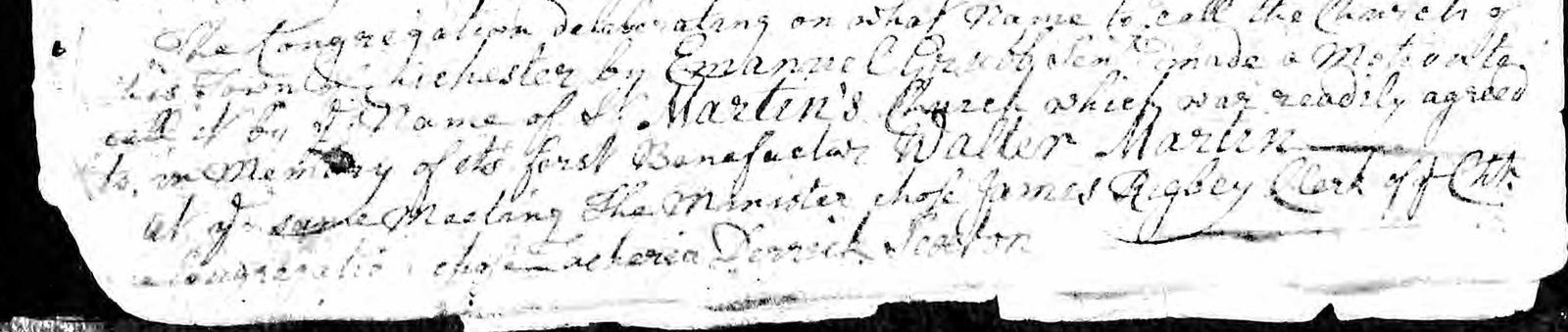
The Congregation deliberating on what Name to call the Church of this Town of Chichester, by Emanuel Grubb Senr made a Motion to call it by ye Name of St. Martin’s Church which was readily agreed to, in Memory of its first Benefactor Walter Martin. At ye same Meeting The Minister chose James Rigbey, Clark of ye Ch[urch]. ye Congregatio[n] chose Zacharia Derrick, Sexton.
The pew ratingsA Seating Plan Is a Social Map
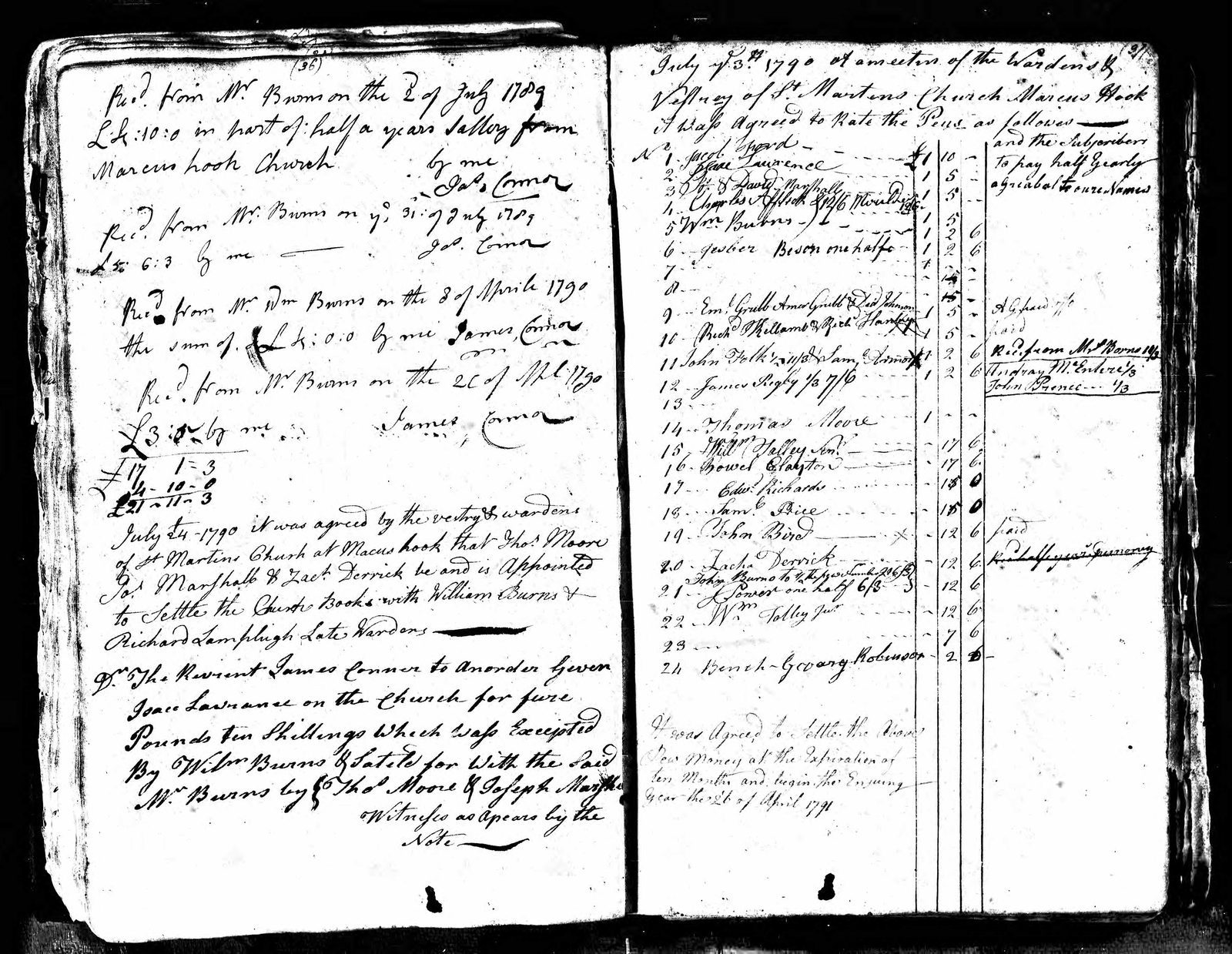
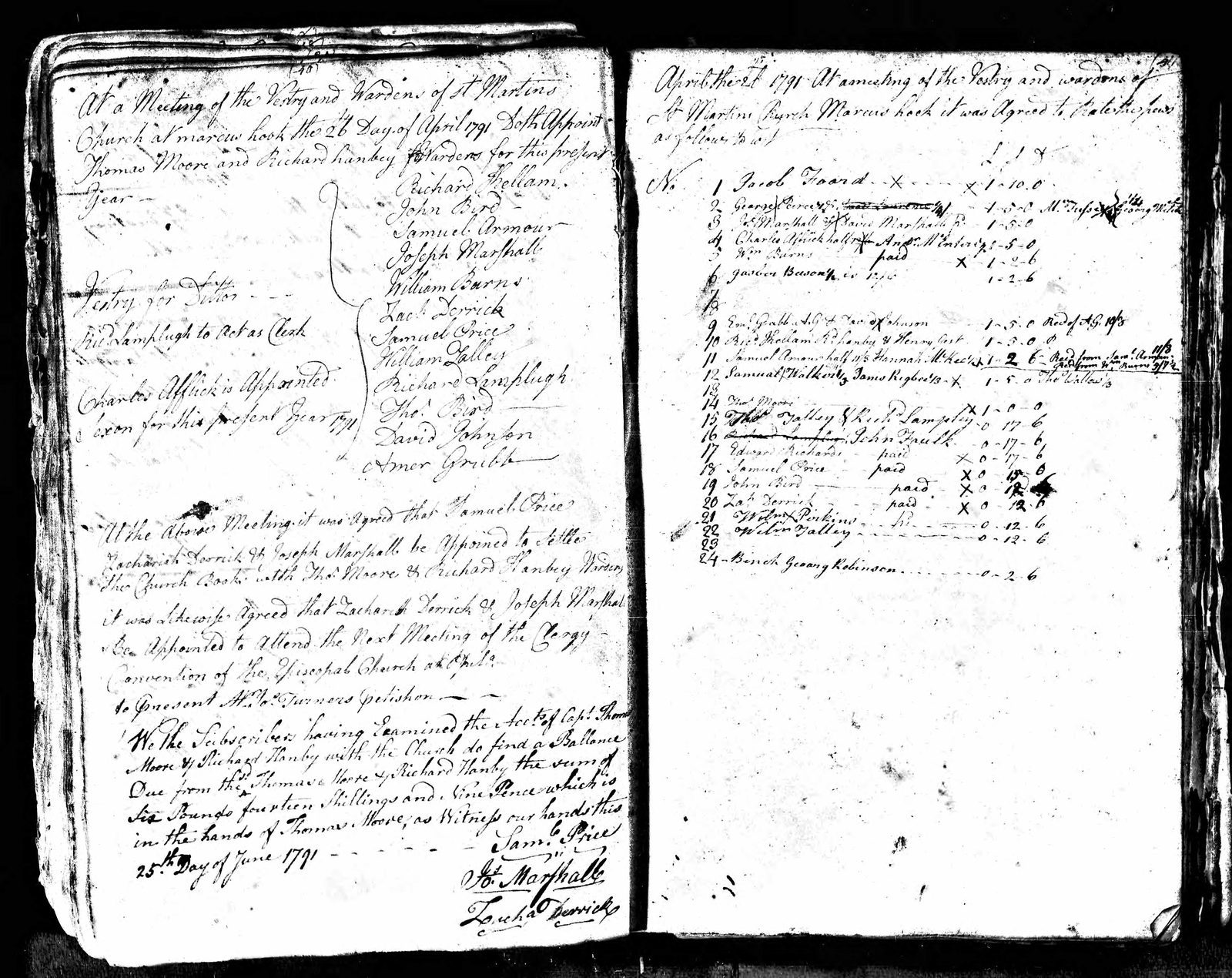
Once a year the wardens and vestry rated the pews, writing down every shareholder’s name and the sum owed. These lists are the nearest thing the parish kept to a roll of its congregation.
There were twenty-four. Pew 1 went for £1 10s. The back pews went for twelve and sixpence, and there was a plain bench at pew 24 for half a crown. Most pews were shared — a half here, a third there — so a rating line often carries two or three names and a bracket.
The recurring families through these decades were the Grubbs, Marshalls, Talleys, Derricks, Flowers, Foards, Robnetts, Kellems, Clarks, Hanbys, Lampleys, Armours, Rileys, Perkins, Powers and Birds. Across four or five consecutive ratings the changes are visible: names dropping out, a widow taking over a share, a pew left blank and later re-let.
The burying groundWhat a Grave Cost, and When It Stopped Costing
Walter Martin’s acre was expressly a burying ground, and the parish managed it. A resolve of about 1781 charged non-parishioners five shillings silver to the sexton for breaking the ground, and named receipts survive — “for the body of Henerey Rice,” 12 August 1782, and John Lavaley the following year.
Then, on 18 April 1797, the vestry resolved “that no Member of this Church Shall pay anny thing for brakeing Ground,” with strangers to pay seven shillings and sixpence.
From that date a member’s grave was free, and free transactions produced no receipts. The burial money after 1797 appears in lump sums: one payment of £1 10s, a single stranger’s fee in 1799, and in the Easter audit of 1803 “Ten Dollars from Zachariah Derrick for Breaking the Ground in Sd Church yard” — four years of burials in one line, no names given.
c.1781, the standing rule “five Shillings Silver money … for breaking ye Ground” — payable by non-parishioners, to the sexton 12 August 1782, a named receipt “for the body of Henerey Rice” 18 April 1797, the rule changed “that no Member of this Church Shall pay anny thing for brakeing Ground and … all Strangers & Furiners Shall pay Seven Shillings & Sixpence.” Easter 1803, the audit covering 1799–1802 “Ten Dollars from Zachariah Derrick for Breaking the Ground in Sd Church yard.”
So the absence of a burial receipt for a member after 1797 is not evidence of anything. The accounts read the same either way.
1831The Book That Has Not Been Found
St Paul’s, the mother church, was not keeping registers in these decades either — and we can prove that rather than merely assume it. Its book contains a leaf ruled and headed “Marriages for ye year 1740” and left entirely blank, and another headed “Burials for ye year 1738,” also blank. The parish ruled up the pages and never wrote in them. No baptism, marriage or burial entry of any kind survives there between 1745 and 1800.
But on 11 February 1831 the Rev. R. U. Morgan wrote this on the index leaf of his register:
There is a Registry belonging to St Martin’s church, Marcus Hook, in which several marriages, Baptisms and Burials are recorded. Rev. R. U. Morgan, rector of St Paul’s Chester in connection with St Martin’s Marcus Hook · 11 February 1831
The mother church was not keeping these registers; the chapel apparently was. That volume has not been located — the register section on the microfilm begins only in the 1820s. If any record survives of James Rigby’s marriage, his children’s baptisms or his burial, it is most likely in it.
St Paul’s is at Chester. St Martin’s is at Marcus Hook. Two churches about seven miles apart under one rectorship. Catalogues and family notes often merge them into “St Paul’s, Marcus Hook,” which is not a real church, and that is a likely reason these registers went unexamined for so long.
Still thereA Rigby in the Churchyard
There is no stone at St Martin’s for James Rigby. The parish’s own typescript gravestone inventory has no James, and a visit in 2026 found none.
There is, though, a Rigby marker in that ground. Enoch Harlan Rigby (1830–1887) — James’s great-grandson, by way of Eli and William Harlan Rigby — served as a private in Company I of the 97th Pennsylvania Infantry, and lies at St Martin’s under a military marker. His line held ground in Lower Chichester and Marcus Hook for more than a century and a half.
The family remained connected to this acre for two hundred years, but the first of them left no marker on it.
Sources
Vestry book and pew accounts of St Martin’s Church, Marcus Hook, 1724–c.1824 — Historical Society of Pennsylvania microfilm, read in full for the years 1724–1803. Registers, vestry minutes and accounts of St Paul’s Church, Chester. The Rev. George Craig’s preface of 1 January 1760, transcribed into the vestry book. Modern typescript parish history and gravestone inventory, filmed with the vestry book. Chester County tax rates, 1781. Field photography, 2026. ⚠ Where the vestry book and a later typescript disagree, the manuscript is followed.